Locorotondo
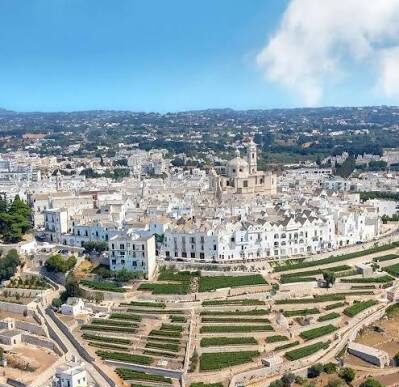
From the valley floor, Locorotondo looks like a white crown set on a hill. Up close, it’s something stranger: a town built in a circle, so perfectly round that its very name means “round place” — locus rotundus. The streets loop back on themselves. You will get lost, and it won’t matter, because every lane eventually delivers you to the same place: the edge of town, and a view across the Valle d’Itria that stops you mid-step.
What Makes Locorotondo Special?
 Locorotondo’s old town is one of the few perfectly circular historic centers in Italy — a ring of whitewashed houses wrapped around the Chiesa Madre di San Giorgio, first mentioned as a “circular hamlet” back in 1195. The houses wear cummerse, steep sloping roofs of local limestone slabs called chiancarelle. They look like trulli that decided to grow up and get jobs: same stone, same valley, completely different silhouette.
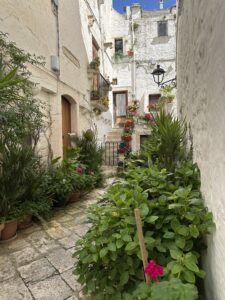
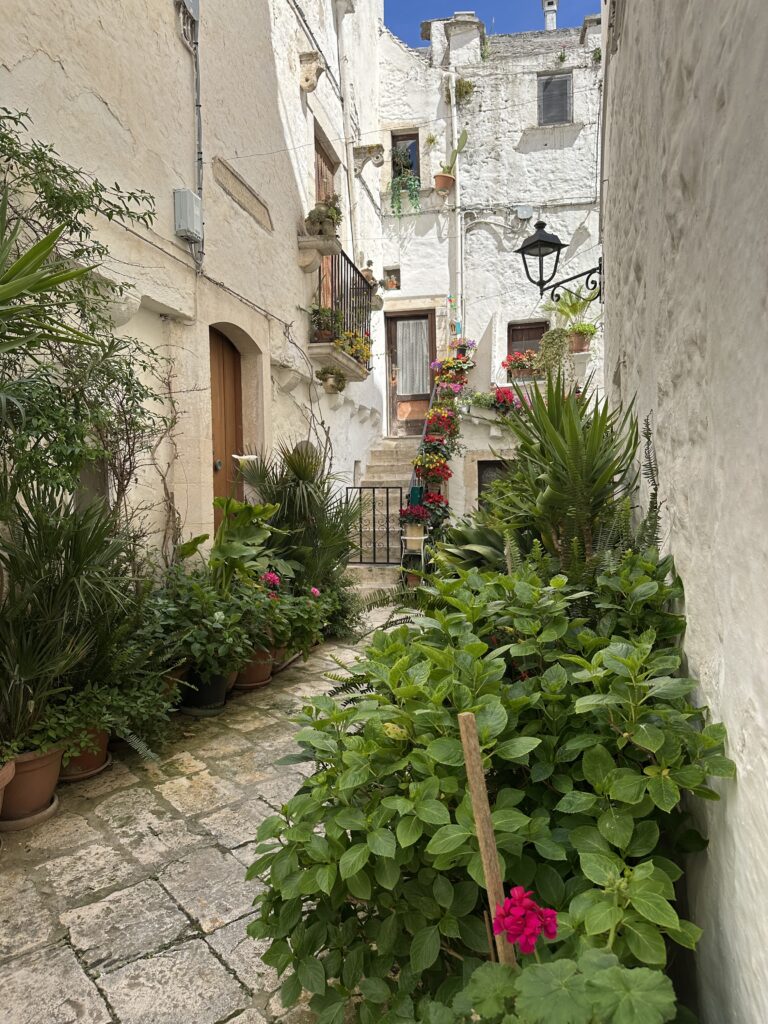
The town is obsessively well kept. Balconies overflow with flowers (there’s a summer competition for the best ones, and the locals take it personally). The lanes are swept, the facades are bright, and the whole place has the calm order of somewhere that knows exactly what it is. Italy noticed: Locorotondo is one of I Borghi più belli d’Italia and holds the Touring Club Italiano’s Orange Flag.
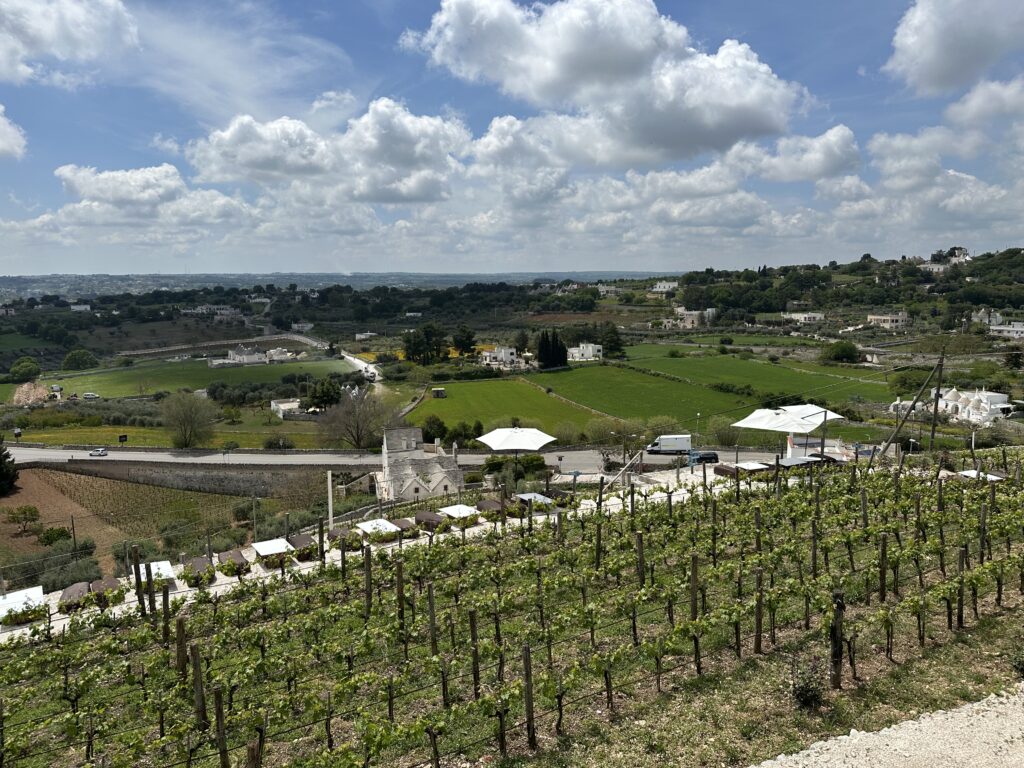
Then there’s the light. At 410 meters up, the town floats above a patchwork of vineyards, olive groves, dry-stone walls, and some 1,500 trulli scattered across the valley like dice. Locals call the panoramic terrace road the ‘lungomare’ — the seafront — even though the sea is nowhere in sight. Stand there at sunset and you’ll understand why they borrowed the word.
A Short, Strange History of Locorotondo
People have lived on this hill since the 3rd millennium BC, and the first real settlement — possibly Greeks from Locri — goes back to the 9th century BC, but the town you see starts in 1195. The records first mention a “circular hamlet” clustered around the church of San Giorgio, under the Hohenstaufen emperors and owned by the monastery of Santo Stefano.
The locals spent the next two centuries trying to escape the monks. They finally broke free in 1385, when the town passed to the Orsini del Balzo family — the great feudal lords of southern Puglia, and a noble family name Galatina knows well. In 1384, just a year earlier, Raimondo Orsini del Balzo — Raimondello, Prince of Taranto — had married Maria d’Enghien, Countess of Lecce. Together they gave Galatina its crown jewel: the Basilica di Santa Caterina d’Alessandria, built between 1369 and 1391 to house Saint Catherine’s finger, which Raimondello had brought back from Mount Sinai. After his death in 1406, Maria had the entire interior covered in frescoes. He’s buried there.
So the Orsini del Balzo ruled both towns in the same decade: Galatina got the basilica, Locorotondo got new landlords — and then unfortunately-the Counts of Conversano. On Christmas Eve 1648, the Count of Conversano sent a gang of bandits led by a man called Capodiferro to sack the town. The people fought them off, credited Saint George with the rescue, and two years later instituted the “Gift of San Giorgio”: a procession in which the mayor hands the keys of the city to the saint.
The gift nearly died in the early 1900s, when two rival workers’ factions — the beduini and the senussi — brawled over who got to march in it, and then the First World War shut it down entirely. When it returned, the town made peace part of the ritual: every April 22, the associations seal their old feud with a symbolic kiss between their flags. They still do it.
The countryside has its own history. In the 1800s, long vineyard leases pushed farmers out into the valley, where they built trulli clustered around shared courtyards called jazzile — the scattered settlement pattern that gives the Valle d’Itria its look. And San Rocco, the town’s second patron, earned his feast by delivering Locorotondo from the 17th-century plague — the same plague that turned Ostuni white.
Why You Should Visit
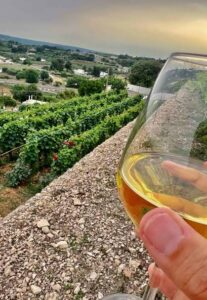
Come to Locorotondo for the opposite of Alberobello: the same valley, the same stone, a fraction of the crowds. Come for the wine — the town gives its name to Locorotondo DOC, a crisp dry white (mostly Verdeca and Bianco d’Alessano, also made sparkling) that tastes like the limestone it grows in. Come to eat your way through the valley’s greatest hits: bombette, capocollo di Martina Franca, and gnumerèdde — lamb tripe roulades slow-boiled in terracotta, the dish the guidebooks are afraid to describe.
It’s also a good base in the Valle d’Itria. Alberobello, Martina Franca, Cisternino, and Ostuni are all within 20 minutes. Stay here, day-trip everywhere to wonderful towns, wineries, and masserias.
10 Things to Do in Locorotondo (and the Area Around It)
1. Get lost in the centro storico
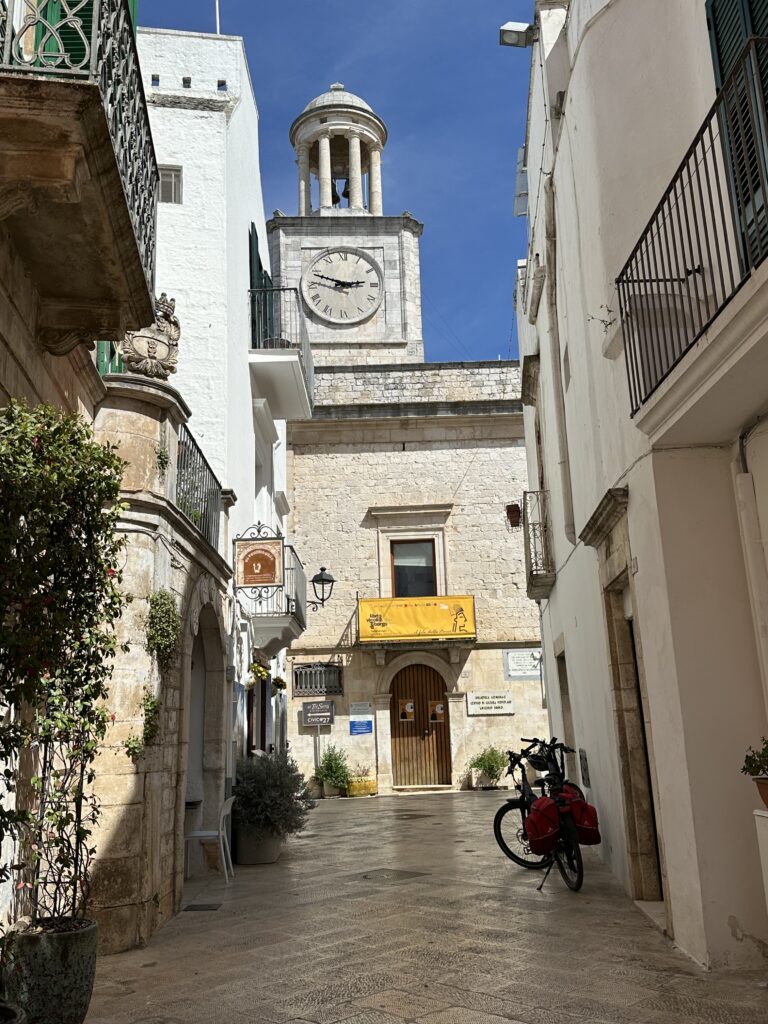
The circular lanes, white facades, carved stone doorframes, and wrought-iron balconies are the main event. Start at Piazza Vittorio Emanuele and let the ring do the navigating. Walk the ‘Luongomare’ at sunset. The terrace road (Via Nardelli) rims the old town with an uninterrupted panorama of the Valle d’Itria. Grab a glass of Locorotondo DOC at one of the bars along it and watch the valley turn gold.
2. Take in the Villa Comunale viewpoint
The 19th-century public gardens just outside the center hold one of the finest valley panoramas in Puglia — vineyards, olive groves, and trulli to the horizon.
3. Visit the Chiesa Madre di San Giorgio
The neoclassical mother church (late 1700s) anchors the town, dedicated to the patron saint. Inside: 42 painted panels of Old and New Testament scenes in the Blessed Sacrament chapel.
4. Step into the Chiesa della Madonna della Greca
One of the town’s oldest churches, documented since 1520, all simple stone elegance.
5. Schedule Mozzarella/Burrata experience
 Southern Visions runs “Secrets of Artisan Burrata” right in Locorotondo: 90 minutes at a family-run farm where master cheesemakers take you from milking through hands-on burrata making, finishing with a tasting of the fresh cheeses.
My top pick is a little further: Masseria Seppunisi in Ceglie Messapica (about 25–30 minutes), a 16th-century farm where you make mozzarella and burrata with your own hands, then sit down to an aperitivo of farm products with a glass of wine.
6. Consider a bike or e-bike tour
 The valley is made for two wheels. Guided e-bike tours loop out of Locorotondo through the heart of the Itria Valley — one popular route runs about 39 km to Martina Franca’s Baroque old town and on to Alberobello’s trulli, all on quiet country lanes lined with dry-stone walls, vineyards, and olive groves, with a gelato stop along the way. The electric assist flattens the valley’s gentle hills, helmets and a local guide are included, and there’s even an optional dairy stop for a cheese tasting (about €10). Bring your own e-bike or rent one on site for around €45.
Puglia On Bike (In Locorotondo) -Highly rated for good equipment, professional setup and great tours.
They offer both e-bike rentals and guided tours of the Valle d’Itria – they’ll also suggest itineraries if you want to ride on your own through the valley’s trulli, vineyards, and olive groves.
7. Taste Locorotondo DOC wine where it’s made.
Book a sommelier-led tasting at a wine estate or in town. (Verdeca, Bianco d’Alessano, Minutolo, and the DOC itself, with handmade taralli), or visit the Cantina Sociale, the town’s social winery and a flag-bearer of local viticulture.
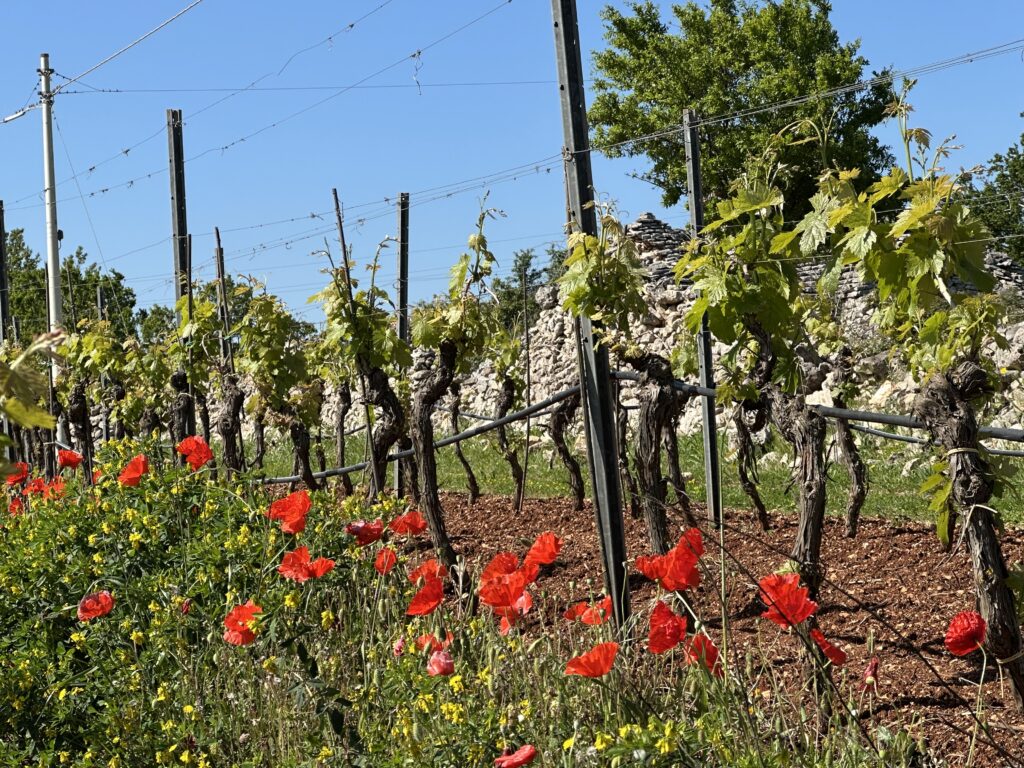
Wine and Wine Estates in Puglia
8. Eat the valley
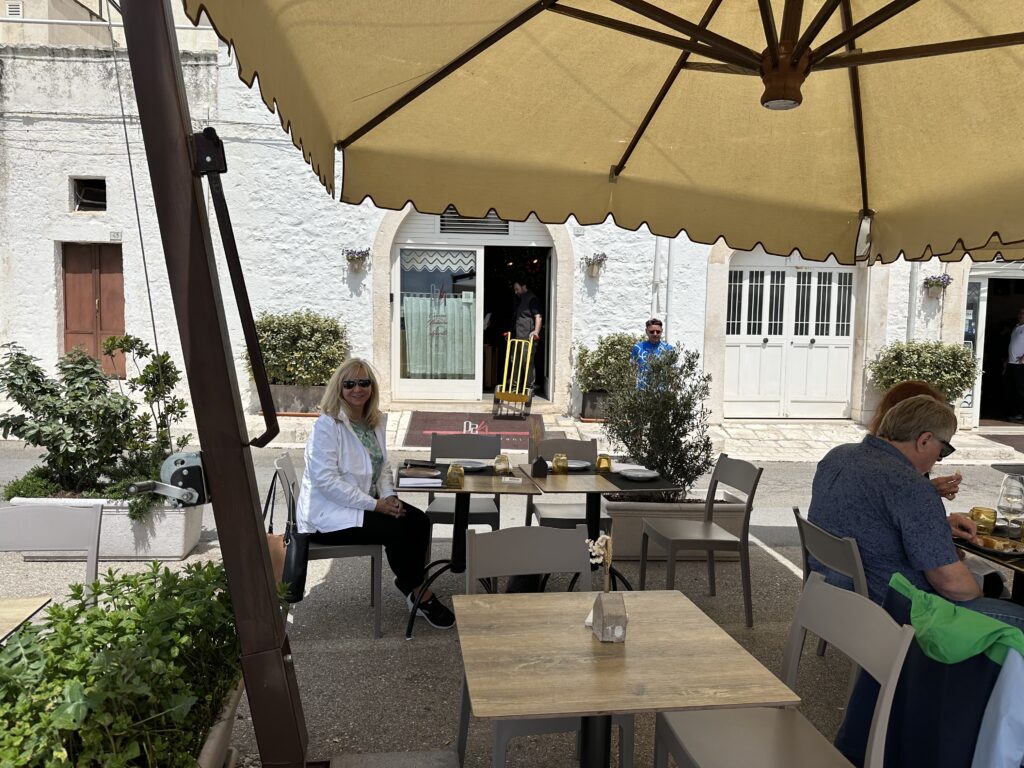
Bombette and orecchiette at U’ Curdunn (with a panoramic terrace), capocollo di Martina Franca and troccoli with white ragù at Osteria Il Rosone, fava e cicoria and grilled zampina at Povero Diavolo. Try the angus stuffed with green pepper and primitivo wine cream, or roasted swordfish with lime with one of the most breathtaking valley views in Locorotondo — sit outside and the whole Itria Valley spreads out below you
9. Day-trip the trulli triangle
Alberobello‘s UNESCO trulli are 10 minutes away; Martina Franca’s Baroque old town and Cisternino’s lanes are 15. Ostuni, the White City, is 20. It is also worth visiting ancient Matera 1 hour and 20 minutes away.
10. Wander the contrade
Locorotondo counts some 130 rural districts, a patchwork of masserie, vineyards, and trulli built around shared courtyards. Drive, cycle, or walk the back roads between them — this is the valley most visitors never see.
Festivals in Locorotondo
The town parties hard for its size. The biggest is the Festa di San Giorgio, April 22–23: processions, concerts, fireworks, and the centuries-old “Gift of San Giorgio” ritual, born from a Christmas Eve attack in 1648 that the townspeople credited the saint with repelling. On April 22, the workers’ associations seal their historic rivalries with a symbolic kiss of peace between their flags.
In August, the Festa di San Rocco (August 14–17) brings days of music — la Diana — and a pyrotechnic display on the 16th that lights up the entire Valle d’Itria. Summer also belongs to music: the Locus Festival, an international jazz, soul, pop, and electronic festival, takes over from late July into mid-August, with the Viva Festival’s avant-garde program following in the second half of August. All summer long, the contrada feasts serve authentic valley cooking in the countryside, and from October into November the Festa del Novello pours the new wine in the old town’s alleys — 30-plus editions and counting.
Christmas in Locorotondo
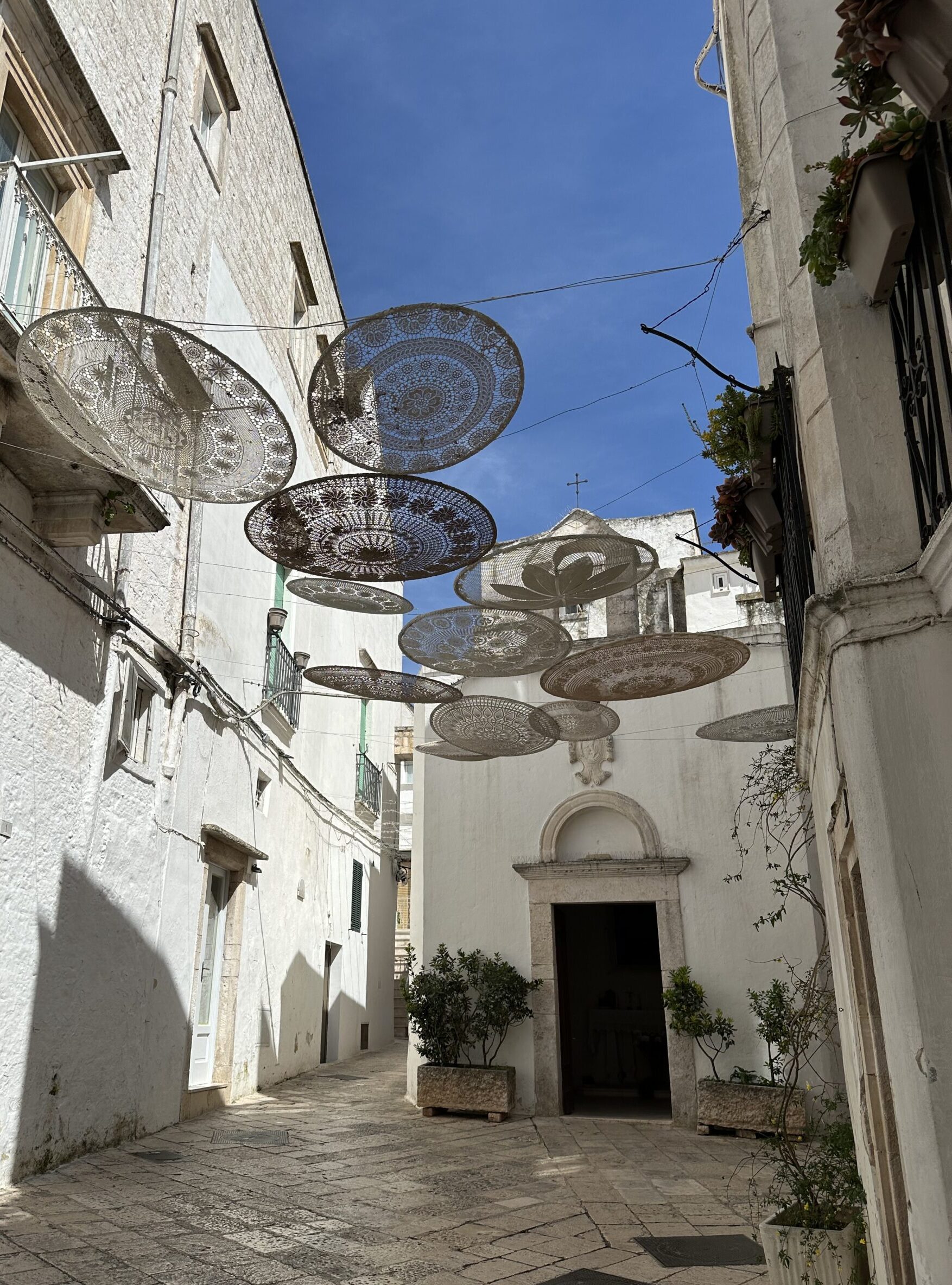
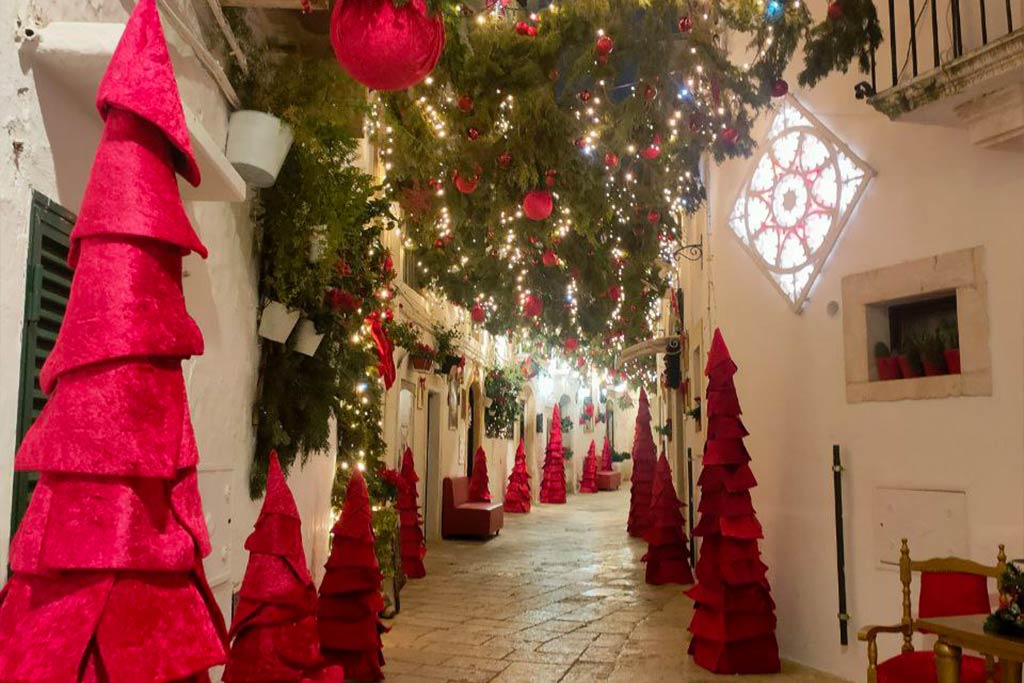
If you think Locorotondo is pretty in summer, come back in December. The town becomes the “Borgo delle Meraviglie” — the Village of Wonders — with Christmas lights switched on in mid-November and glowing through early January across Via Nardelli, Corso Umberto, Piazza Mitrano, and the whole historic center: light arches, themed installations, and corners built for photographs. Mama Mia!
The Christmas market runs from late November to Epiphany around Piazza Aldo Moro, the public gardens, and the streets by the Town Hall — local handicrafts, nativity scenes, typical products, street food, and live music on the busy evenings. Don’t miss the Presepe Sospeso, the “suspended nativity” on Via Vittorio Veneto, and the living nativity performed by locals in the old town’s lanes. Pair it with Alberobello’s trulli lit up for Christmas, ten minutes away, and you have the Valle d’Itria’s best winter weekend. Christmas is popular here- expect crowds, and difficulty with parking.
Practical Notes
Locorotondo sits in the province of Bari, about 70 km from Bari airport and 35 km from Brindisi. You need a car — the valley rewards drivers. Half a day covers the town; a full day lets you add a winery and a long lunch. As a base, two or three nights puts Alberobello, Martina Franca, Cisternino, Ostuni, and the best masserie of the valley all within easy reach.
Come for the circle. Stay for the wine, the quiet, and the sunset over the valley. Locorotondo is the town the tour buses drive past — which is exactly why you shouldn’t.

FAQ’s
 How many days do you need in Locorotondo?
Half a day covers the old town, the lungomare walk, and the Villa Comunale viewpoint. A full day adds a winery tasting and a long lunch. As a Valle d’Itria base, give it two to three nights — Alberobello, Martina Franca, Cisternino, and Ostuni are all within 20 minutes.
Is Locorotondo worth visiting instead of Alberobello?
Visit both — they do different things. Alberobello has the UNESCO trulli; Locorotondo has the calm: a perfectly circular white old town, valley panoramas, the DOC wine, and a fraction of the crowds. If you dislike crowds, Locorotondo is the better overnight base.
Where should I stay in Locorotondo — the town or the countryside?
The old town puts you inside the circle for evening strolls and aperitivi on the lungomare. The contrade (Locorotondo counts about 130) offer masserie and trulli stays among vineyards — better for drivers who want quiet and a pool. Either way, you need a car.
Can you visit Locorotondo without a car?
The town itself is walkable once you arrive, but getting there and exploring the valley without a car is difficult. Buses connect the main towns sparsely; the wineries, contrade, and day trips really require driving.
What is Locorotondo DOC wine and where do I taste it?
A crisp dry white made mostly from Verdeca and Bianco d’Alessano (also made sparkling), grown on the valley’s limestone. Taste it on the lungomare bars, at a sommelier-led tasting in town, or at the Cantina Sociale, the town’s social winery.
Is Locorotondo good at Christmas?
Yes — it’s one of the Valle d’Itria’s best winter stops. As the “Borgo delle Meraviglie,” the historic center glows with light installations from mid-November to early January, the Christmas market runs around Piazza Aldo Moro through Epiphany, and there’s a suspended nativity plus a living nativity in the old lanes. Pair it with Alberobello’s lit-up trulli, ten minutes away. Expect crowds and scarce parking.