The Gargano Coast
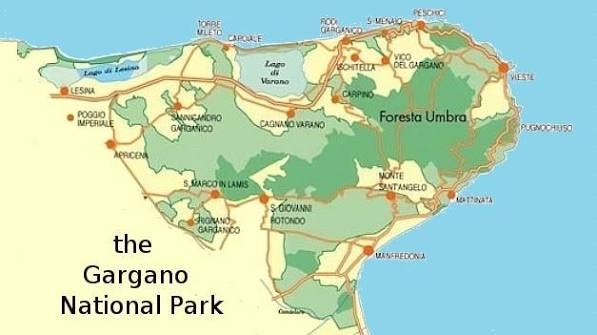
If Puglia is the heel of Italy’s boot, the Gargano is the spur — a great limestone promontory jutting into the Adriatic, so distinct from the rest of the region that it was once an island of its own. That ancient isolation is still visible everywhere: in the forests, the wildlife, the white cliffs, and the fishing machines that exist nowhere else in Italy.
Most visitors to Puglia never get here. They stop at Bari, or turn south toward the trulli and the Salento beaches, and the Gargano stays quiet — which is exactly why it rewards the trip. This is Puglia at its wildest: a national park the size of a small country, a coast carved into twenty sea caves, a beech forest older than most of Europe’s cathedrals, and an archipelago that feels like Greece.
Base yourself in Vieste, and the whole spur opens up from there.
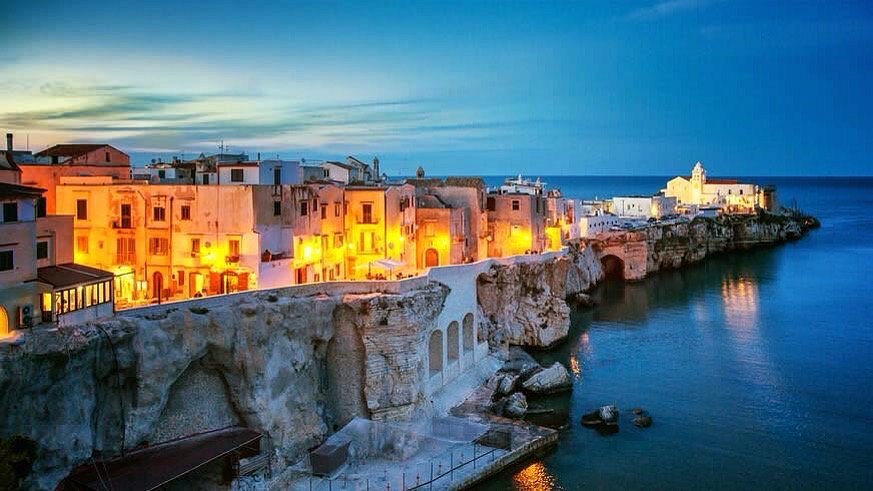
Vieste, the Pearl of the Gargano
Vieste sits on a white limestone headland, its old town a maze of narrow lanes, whitewashed houses, and stairways that open suddenly onto the sea. It is called the Pearl of the Gargano, and the nickname is earned — but Vieste is not a resort pasted onto a beach. It is a working fishing town that happens to be beautiful.
Start in Vieste Vecchia, the old town, and climb toward the top. The Cathedral of Santa Maria Assunta is one of the oldest examples of Puglian Romanesque, built in the 11th century, with a tall Baroque bell tower capped by a delicate onion dome. Beside it stands the Swabian Castle, still in military use — admire the exterior, since public access is limited to selected events. Look for the Chianca Amara, the “bitter stone” locals point to when they tell the town’s darker stories.
Then walk down to the beach and meet Pizzomunno. The great white monolith rises about 25 meters from the sand at the edge of town, and it is the symbol of Vieste. Local legend says it is a young fisherman turned to stone, waiting forever for his beloved, the mermaid Cristalda, stolen away by jealous sirens. Go at sunset, when the cliff catches cleaner light and the crowds thin.
Vieste’s beaches run long on both sides of the headland: Scialara, also called Spiaggia del Castello, right below the old town; San Lorenzo, a hidden crescent tucked among the rocks; and the long golden stretch at Pizzomunno beach itself. On the other side of the headland, Marina Piccola sits directly beneath the historic center, and the walk around Punta San Francesco is particularly good in the evening.
The Sea Caves: The coast you can only see by boat
The coastline south of Vieste toward Mattinata is the strongest reason to spend more than a single day here. White limestone cliffs drop straight into the Adriatic, broken by beaches, natural arches, and about twenty sea caves that can only be visited from the water.
Boat excursions leave from Vieste’s harbour and follow the coast south toward Baia delle Zagare, entering the accessible caves when sea conditions allow. The caves were first explored and named in 1954 by a Vieste fisherman, Michele Trimigno, who took shelter in them during a storm and then began guiding visitors — his family still runs boat tours today. Among the named caves are Grotta Sfondata (the Broken Cave), Grotta Campana (the Bell Cave), Grotta dei Contrabbandieri (the Smugglers’ Cave), Grotta dei Due Occhi, Grotta dei Colombi, Grotta delle Sirene, and Grotta dei Sogni.
Allow around three hours for a typical excursion, with swimming stops along the way — some boats offer a beach service and even a grilled-fish lunch at Porto Greco. Tours generally run from April 1 to October 31st, with morning and afternoon departures, but cave access always depends on wind and sea state. Book the morning departure if you can: the light inside the caves is better, and the sea is usually calmer.
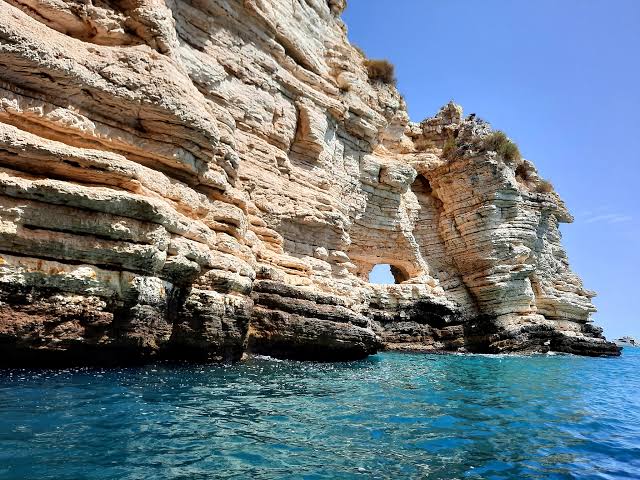
Baia Delle Zagare and Mattinatta
Halfway down that same coast lies the Gargano’s most photographed bay. Baia delle Zagare — also called Baia dei Mergoli — is a white-pebble cove beneath towering cliffs, with two limestone sea stacks, the faraglioni, rising from turquoise water just offshore. The taller stack reaches about 74 meters, and international media have named the bay one of the most beautiful beaches in the world.
It is also the Gargano’s most regulated beach, so plan ahead. The bay sits about 35 km from Vieste and 14 km from Mattinata on the SS89 coastal road. If you are not staying at one of the cliffside hotels above the bay, public access in peak season (June to September) is limited to 30 people per day, with a free permit from the Mattinata municipality office. Outside peak season, public access is unrestricted — and in July and August, the simplest way in is by boat, as part of a Gargano coast tour. June and September are the sweet spot: warm sea, manageable crowds, and the permit limit less likely to be exhausted before you arrive.
While you are in Mattinata’s territory, history lovers should stop at the Monte Saraceno necropolis, about 5 km outside town toward Manfredonia: some 500 Daunian tombs carved into bare rock, dating from the 8th to 7th centuries BC, many in a characteristic womb-like shape. Admission is free, and the site is at its best in late-afternoon light. Higher up, at around 874 meters on Monte Sacro, lie the overgrown ruins of the Abbey of the Holy Trinity, first mentioned in a document in 1058 — a proper hike, with sturdy shoes and mosquito repellent.
Peschici and Trabucchi
North of Vieste, perched on an 80-metre limestone cliff above a horseshoe bay, Peschici is the Gargano’s other great white town. Its 10th-century old town is a labyrinth of cubic whitewashed houses, flat rooftops, narrow alleyways, and stone staircases, watched over by a Norman-Swabian castle. Below it lie some of the coast’s best family beaches: Baia di Manaccora, Zaiana, San Nicola, and Cala Lunga.
But Peschici’s real signature stands in the water. The trabucchi are ancient wooden fishing machines on stilts — great spider-like structures of timber and nets that have worked this coast for centuries and exist in this form almost nowhere else. Some still fish. Others have become restaurants, which is the most memorable way to experience one: dinner on a trabucco, suspended over the Adriatic, eating what the sea brought in that day. The most famous are around Peschici — Al Trabucco da Mimì, run by the Ottaviano family at Punta San Nicola, and the Trabucco di Monte Pucci, the largest and oldest of its kind, with 360-degree views. Book ahead, and go for sunset.
Foresta Umbra: The Green Lung
Drive twenty minutes inland from the coast and Puglia changes completely. The Foresta Umbra is the ancient beech forest at the heart of the Gargano National Park — more than 10,000 hectares of beech, maple, holm oak, and monumental turkey oak, with trees over 40 meters tall and some beeches more than 500 years old. Its beeches were inscribed by UNESCO in 2017 as part of Europe’s primeval beech forests.
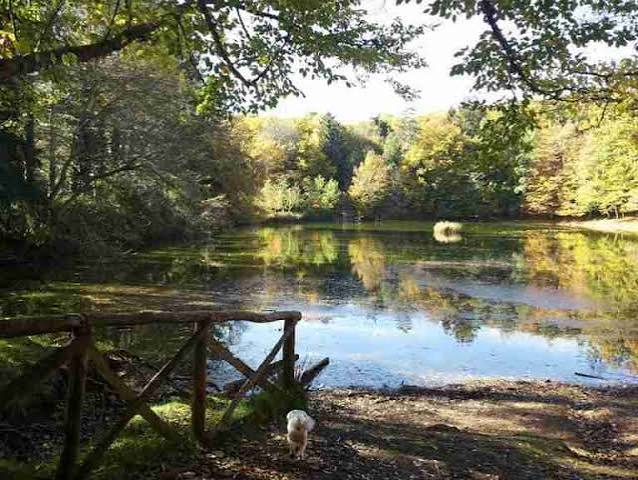
The name means “shady,” and it fits: the canopy is so dense that the forest floor stays cool even in high summer, which makes it the perfect escape from August heat on the coast. There are more than 100 km of marked trails and around 15 equipped paths for every level, plus accessible paths near the Laghetto d’Umbra, the little lake where turtles and fish live. The forest holds more than 2,000 plant species, including 65 kinds of wild orchid — a Mediterranean record — and wildlife from the shy Gargano roe deer and wild cats to woodpeckers, owls, and, in recent years, the returning Apennine wolf, a sign of an environment in excellent health.
The forest is about 26 km from Vieste, in the municipality of Vico del Gargano — worth a detour in its own right as the “Village of Love,” whose patron is Saint Valentine himself, celebrated every 14 February with oranges, lemons, and bay leaves. The Casa Umbra visitor centre has maps and audio guides, and there is a trattoria right in the forest for lunch after a walk.
The Tremiti Islands: The Adriatic’s only archipelago
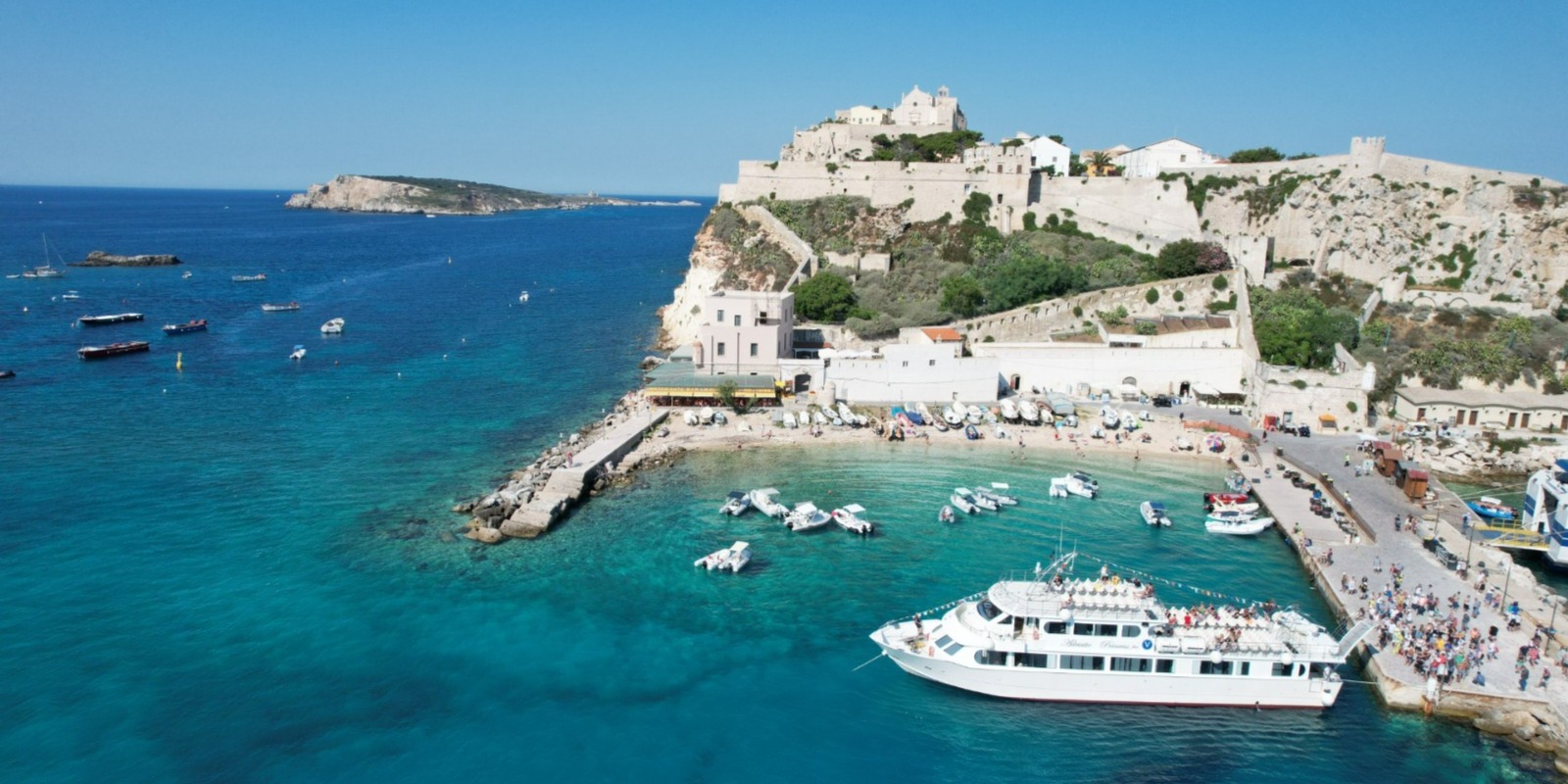
From Vieste, the Gargano’s last surprise is out to sea. The Tremiti Islands — San Domino, San Nicola, Capraia, Cretaccio, and Pianosa — are the only island group off Italy’s Adriatic coast, and they are part of the national park. Legend calls them the Diomedee, after the Greek hero Diomedes.
In summer, ferries run from Vieste, Peschici, and Rodi Garganico; outside summer, Termoli is the year-round port. It is a full day out, and worth every minute.
Choose your island by mood. San Domino is the largest and greenest, the one the Lateran monks called the “Earthly Paradise” for its flowers and thick pine forest. Its coves — Cala delle Arene, the islands’ sandy beach, plus Cala Matano, Cala degli Inglesi, and Cala Tonda — are made for swimming, and its caves, the Grotta delle Viole and Grotta delle Rondinelle, are made for photographs. San Nicola is the historic island: climb the Salizada from the port past the Crucifix Tower and Badiali Castle to the Benedictine Abbey of Santa Maria a Mare, which has guarded this strategic speck of rock for centuries. A three-hour boat tour around the islands, with stops in the most beautiful coves, is an easy add-on once you arrive.
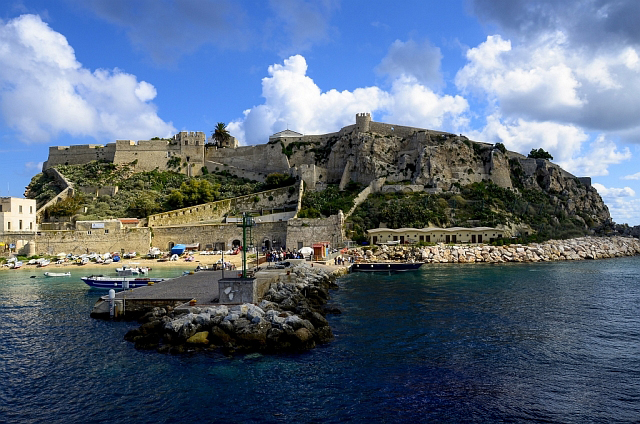
10 Great things to do in the Tremiti Islands
1. Swim the Coves of San Domino
Cala delle Arene is the islands’ sandy beach and the best family pick, with calm, shallow water. Then there’s Cala Matano, Cala degli Inglesi, and Cala Tonda — smaller, rockier, and quieter.
2. Take the Boat Tour Around the Islands
About 3 hours, and it’s the only way to see the archipelago properly — the cliffs, hidden coves, and sea caves that are inaccessible by land, including the Grotta delle Viole, Grotta delle Rondinelle, the Architiello rock arch, and Punta del Diavolo.
3. Walk San Nicola’s Historic Core
Climb the Salizada from the port past the Crucifix Tower and Badiali Castle up to the Benedictine Abbey of Santa Maria a Mare — the fortress-monastery that has guarded this strategic speck of rock for centuries.
4. Dive or Snorkel the Marine Reserve
The water here is famously clear, with coral seabeds and colorful marine life. The signature dive is the submerged statue of Saint Padre Pio between Capraia and San Nicola, and there are dive shops right at San Domino’s little port.
5. Walk San Domino’s Pine Forests to the Viewpoints
The island the monks called the “Earthly Paradise” is covered in Aleppo pines with easy walking paths. Head to Colle dell’Eremita, the island’s highest point, for views over the whole archipelago, or out to the lighthouse at Punta del Diavolo.
6. Take in Wild Capraia
The archipelago’s uninhabited island — no town, no roads, just rugged cliffs and some of the clearest water in the group. Best reached as a boat stop for swimming and snorkeling away from the crowds.
7. See the Two Forgotten Islands, Cretaccio and Pianosa
Cretaccio’s pale clay cliffs sit right between San Domino and San Nicola, and flat, uninhabited Pianosa is part of the marine reserve — both are best admired from the water, which completes the full five-island circuit.
8. Eat Dinner on San Domino at Sunset
A terrace table on Cala delle Arene (Bel Mare) or Da Enrichetta, the islands’ special-occasion table, with the day’s catch — the perfect end to a day that started in the water.
9. Go Birdwatching for the Shearwaters
Scopoli’s and Yelkouan shearwaters breed here in large numbers — the very “diomedee” birds of the Diomedes legend the islands are named for — along with peregrine falcons. April to mid-June is the best window, when the widest range of birds is present.
10. Visit the Grotta del Bue Marino and the Roman Wreck
On San Domino’s coast, reachable only by boat: the Grotta del Bue Marino sea cave, and at Punta di Ponente the wreck of a Roman ship — two specific stops that make a boat day feel like an expedition rather than a tour.
Where to eat on the Gargano
Gargano cooking is seafood first, with the promontory’s own products behind it: troccoli pasta, octopus ragù, caciocavallo podolico cheese, and Gargano DOP olive oil. These are the tables worth planning around.
Vieste
Ristorante La Ripa — In the old town, inside a beautifully restored 15th-century convent with stone vaults. Chef Anna Cariglia refines rather than reinvents Puglian tradition: troccoli pasta with cuttlefish sauce and the legendary stuffed mussels Vieste-style. The romantic pick.
Il Capriccio — Right on the harbour, with modern, forward-thinking seafood and raw seafood platters presented like fine dining. Save room for the reinterpretations of cartellate, the traditional Puglian sweet.
Osteria Al Duomo — In the historic centre, in a charming 15th-century stone building, with an exceptional seafood menu and traditional dishes at surprisingly affordable prices.
Donna Maria Osteria Contemporanea Pizzeria — TheFork users’ favourite in Vieste, for seafood and pizza alike.
Peschici – The Trabucchi
Al Trabucco da Mimì
Dinner on the Ottaviano family’s historic trabucco at Punta San Nicola, over the water, with the day’s catch. Rated 4.7 from more than 1,150 reviews. Book ahead.
Trabucco di Monte Pucci
The largest and oldest trabucco of its kind, jutting from the Monte Pucci headland with 360-degree views. A daily-changing fish menu, and sunset is the moment to be there. Rated 4.9 from 201 reviews.
La Taverna di Peschici
In the old town’s ancient lanes, once a refuge for pirates and seamen, now one of the Gargano’s most praised tables. Rated 4.9 from 235 reviews.
Tremiti Islands
Da Enrichetta
On San Domino, chef Simone Brasiello pairs traditional fish dishes with an inventive, sometimes exotic touch. The islands’ special-occasion table.
Bel Mare
A long-standing reference on San Domino, with a terrace on Cala delle Arene, the islands’ finest sandy beach, two steps from the port.
The Gargano in 3 Days (+1 for the Tremiti)
THE GARGANO IN 3 DAYS (+1 FOR THE TREMITI)
Day 1 — Vieste old town, the cathedral and castle exterior, Pizzomunno at sunset, dinner at La Ripa or Il Capriccio.
Day 2 — Morning sea-cave boat tour toward Baia delle Zagare, with swimming stops; afternoon at Scialara or San Lorenzo beach.
Day 3 — Morning in Monte Sant’ Angelo, afternoon in Peschici’s old town, dinner on a trabucco at sunset.
Day 4 (optional, and worth it) — Ferry to the Tremiti: San Domino’s coves in the morning, San Nicola’s abbey in the afternoon.
Practical Notes
Getting there: the Gargano rewards a car. Bari airport is about 180–200 km away, roughly 2.5 to 3 hours’ drive; Foggia is about 2 hours. Vieste has no train station — buses run from Foggia and San Severo — and the SS89 coastal road between Vieste and Mattinata is one of the great drives in Puglia. A car is optional for Vieste itself but strongly useful for the wider Gargano.
When to go: May–June and September are the best months — warm sea, open businesses, manageable crowds. July and August bring peak crowds and the Baia delle Zagare permit system. Vieste is strongly seasonal: many tourism businesses reduce hours or close outside the main season, though the town itself stays visitable in winter.
Where to stay: Vieste is the natural base, with 2 to 4 days the recommended stay. For a longer trip, pair it with Monte Sant’Angelo — the sanctuary of San Michele, another UNESCO site, is already covered in full on this site — or fold the Gargano into a northern Puglia itinerary.
The Gargano is Puglia without the filter: wilder, quieter, and further from the postcard. Come for the caves and the forest and the islands, and you will understand why the people who know Puglia best keep this spur for themselves.
FAQs on the Gargano Coast
How many days do you need for the Gargano?
Three days covers the essentials with Vieste as your base: one day for Vieste old town and Pizzomunno, one for the sea-cave boat tour, and one split between the Foresta Umbra and Peschici. Add a fourth day for the Tremiti Islands ferry trip. Vieste itself deserves 2 to 4 days; anything less turns the coast into a drive-by.
Do you need a car on the Gargano?
For Vieste itself, no — the old town and main beaches are walkable. For the wider Gargano, yes, a car is strongly recommended: the Foresta Umbra, Peschici, and Baia delle Zagare are all outside town, and Vieste has no train station. Buses run from Foggia and San Severo, but they will not get you to the forest trails or the permit-only beach on your own schedule.
Can you visit the Tremiti Islands as a day trip?
Yes, in summer, when ferries run from Vieste, Peschici, and Rodi Garganico. Outside summer, Termoli is the year-round port. Pick San Domino for beaches and swimming (Cala delle Arene is the islands’ sandy beach) and San Nicola for history (the Benedictine Abbey of Santa Maria a Mare). A three-hour boat tour around the islands is an easy add-on once you arrive.
How do you get to Baia delle Zagare?
Three ways: by car on the SS89 between Vieste and Mattinata (35 km from Vieste, 14 km from Mattinata) and then on foot down the steep public path; by boat from Vieste or Mattinata on a Gargano coast tour; or as a guest of one of the cliffside hotels with direct access. In peak season (June to September), public land access is limited to 30 people per day with a free permit from the Mattinata municipality office — in July and August, the boat option is the most practical for day visitors.
When is the best time to visit the Gargano?
May–June and September: warm sea, open businesses, manageable crowds, and the Baia delle Zagare permit limit less likely to be exhausted. July and August bring peak crowds and the toughest access logistics. Vieste is strongly seasonal — many tourism businesses reduce hours or close outside the main season — though the town itself stays visitable in winter.
Are the Gargano sea caves accessible without a boat?
The roughly twenty caves between Vieste and Mattinata can only be visited from the water, by small boat, larger motorboat, or kayak. Tours generally run 1 April to 31 October with morning and afternoon departures, and cave entry always depends on wind and sea conditions — allow around three hours for a typical excursion