Altamura
Altamura is not the Puglia of the postcards. There is no sea here, no whitewashed fishing port, no trulli on the skyline. This is the Murgia: a high, stony plateau inland from Bari, all wheat fields, dry-stone walls, and wide skies, and a working city of about 70,000 people that most visitors drive straight past on their way to Matera.
That is their mistake. No other town in Puglia packs so much deep time into one place. Altamura holds Europe’s first DOP bread, the most complete Neanderthal skeleton ever found, and a quarry floor covered in tens of thousands of dinosaur footprints. Add a cathedral built by Frederick II and a rebellion that earned the city the nickname “Lioness of Puglia,” and you have one of the strangest, richest day trips in the region.
The Bread that made the city famous
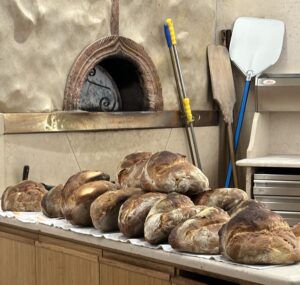 Start with the bread, because in Altamura everything starts with the bread. Pane di Altamura is made from re-milled durum wheat semolina — at least 80 percent from locally grown varieties — mixed with water, salt, and a natural sourdough starter, then baked in oak wood-fired ovens. The loaves are big, sold by weight, with a thick crust (at least three millimeters by law) and a yellow crumb that keeps for days.
In 2003 it became the first bread in Europe to receive DOP status, the EU’s protected designation of origin. That means the name can only be used for bread made here, to a strict recipe, with these ingredients. Bread made the same way elsewhere has to call itself “pane tipo Altamura” — Altamura-style bread. It is not the same thing.
The tradition is old. The Roman poet Horace wrote in 37 BC that the bread here was so good the wise traveler carried a supply for the onward journey. The first preserved records of bakery activity in the city date to 1527. The old stone ovens, some built in the nineteenth century with room for 300 kilos of bread at a time, are still part of the townscape, and the bread still goes into the ovens at dawn so it is on the counters in the early morning.
There are two kinds: airy (skuanète in dialect) and dense. Buy it warm from a bakery in town, tear it open, and eat it with nothing but good olive oil and ripe tomatoes. And if you want the peasant version of the story, ask about the stale-bread dishes — cialda fredda and pane cotto — born from a time when a loaf had to last a week and nothing was thrown away.
The Man in the Cave
In October 1993, cavers exploring the Lamalunga Cave outside Altamura dropped down a ten-meter sinkhole, followed a tunnel, and found something extraordinary in a small chamber: a complete human skeleton, lying on its back, encased in calcite. It became known as the Altamura Man.
He is a Neanderthal, an adult male, who lived between about 130,000 and 187,000 years ago. He is one of the most complete Paleolithic skeletons ever discovered in Europe — researchers like to point out that even the bones inside his nose are still there. The calcite that sealed him in also preserved him so well that his remains yielded the oldest Neanderthal DNA ever successfully sequenced.
He has never been moved. The skeleton still lies in the cave, in a chamber called the Apse of Man, with only the skull and part of a shoulder visible through the calcite crust. That is a deliberate choice: pulling him out would risk destroying him. The story is told in town, at the state archaeological museum, which also holds the vases, terracottas, and tomb finds from the area’s ancient settlements.
The Dinosaur Quarry
If the Neanderthal is Altamura’s deep past, the dinosaurs are its deeper past. In May 1999, two marine geologists surveying an abandoned limestone quarry at Contrada Pontrelli, on the road toward Santeramo, noticed something odd in the rock floor. It turned out to be one of the most important dinosaur track sites in Europe.
The quarry floor holds tens of thousands of footprints, pressed into a tidal flat some 70 to 80 million years ago, in the Late Cretaceous. They belong to around two hundred animals across five groups — herbivores and carnivores, small and large, with prints ranging from five centimetsers to forty-five, left by animals up to ten meters tall. You can read gaits in them: most of the animals were walking calmly, grazing, not fleeing. One newly identified trackway was even given a name that ties the site to the city’s other history: Apulosauripus federicianus, after Frederick II.
The site now sits inside the MurGeopark UNESCO Global Geopark, recognized in 2024. The quarry itself is not reliably open to visitors, so check before you go rather than turning up at a closed gate. The museum in town is the dependable way into the story.
Frederick II’s Cathedral
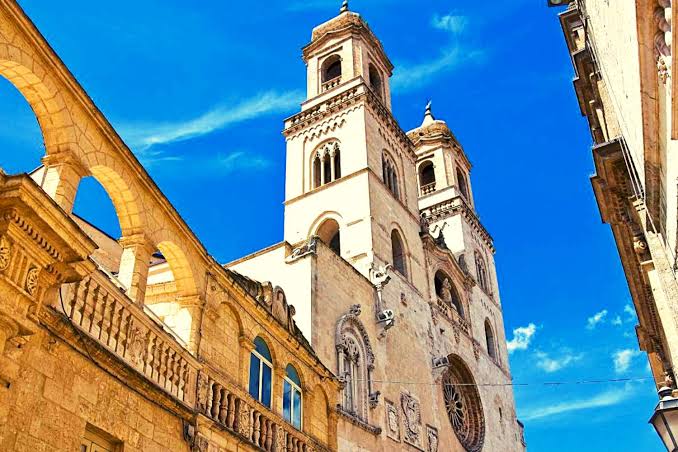
Altamura’s old city had been looted by the Saracens and left empty for centuries when Emperor Frederick II re-founded it in 1232. He ordered the building of the cathedral of Santa Maria Assunta, constructed between 1232 and 1254, and in 1248 had it declared exempt from the jurisdiction of the bishop of Bari — a “palatine church,” answerable effectively to the emperor himself. It is one of only four such churches in Puglia, alongside San Nicola in Bari, Acquaviva delle Fonti, and Monte Sant’Angelo.
Stand in Piazza Duomo and look up. The rose window, from the fourteenth century, has fifteen small columns radiating around a central Lamb of God, and it is one of the most intricate in Puglia. Below it, the Gothic portal stands on two stone lions, and its arch carries twenty-two sculpted panels telling scenes from the life of Christ, from the Annunciation to Pentecost.
The building has been turned around since Frederick’s day: a fourteenth-century restoration, after the earthquake of 1316, reversed its orientation, so the main portal now opens onto the square. The second bell tower, the altar area, and the sacristy came in the sixteenth century. The medieval walls Frederick built still rest, in places, on megalithic walls raised between the sixth and third centuries BC.
The Lioness of Puglia
Altamura does not just have old stones; it has a temper. In 1799 the city joined the Parthenopean Republic, the short-lived revolutionary government in Naples, and governed itself from February 8 to May 9. On May 9, the Sanfedisti — the royalist forces of Cardinal Fabrizio Ruffo — reached the walls, fought their way in, and sacked the city.
The resistance earned Altamura its nickname: the Leonessa di Puglia, the Lioness of Puglia. During the Risorgimento the city was the seat of the Bari insurrection committee, and after unification it served briefly as the provisional capital of Apulia. The feuding families who ruled it in between — the Orsini del Balzo and the Farnese, from 1538 to 1734 — left the palaces and churches that fill the old town, along with a university Charles VII of Naples founded in 1748.
Walking the Old Town
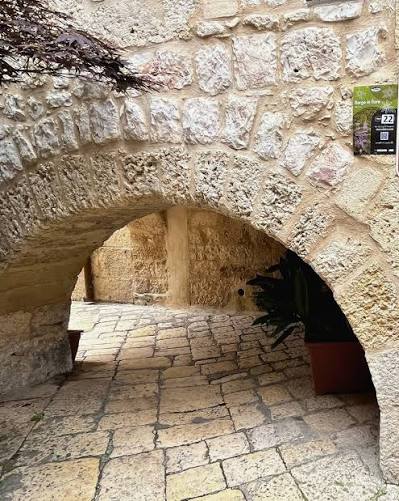
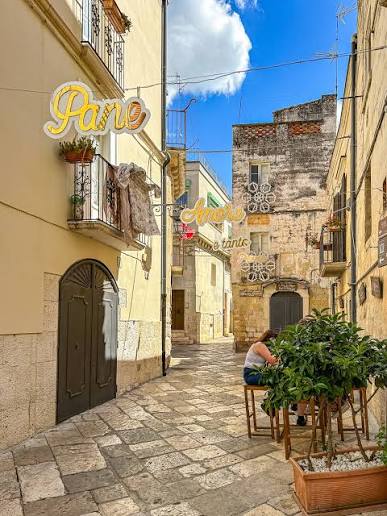
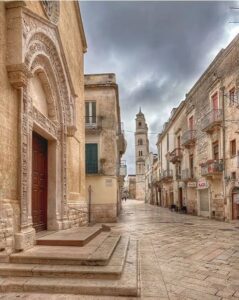 The historic centr rewards wandering. The lanes are stone, narrow, and lived-in, and tucked into them are the claustri: small, enclosed courtyards, shared by the houses around them, that are Altamura’s most characteristic piece of town planning. Look for the palaces as you walk, and for the churches of San Biagio and San Nicola dei Greci beyond the cathedral.
Then get out of town. About six kilometers northwest, in the Alta Murgia National Park, is the Pulo di Altamura: a vast karst sinkhole, more than 500 metres across and 70-plus metres deep, its walls pierced by caves and rock shelters that people have used for over 5,000 years, including medieval hermitages. Trails run the rim and down inside. It is the Murgia at its most dramatic — and a reminder that this plateau, all wheat and stone and sheep, is a completely different Puglia from the coast, and worth a trip on its own terms.
3 Best Restaurants in Altamura for traveling Foodies
1. La Locanda di Alice
The special-occasion pick. Italian with a seafood focus, in the top price range. The one to book for a proper night out.
2. Origini Vino & Cucina
The wine lover’s pick. Italian and Mediterranean cooking with vegetarian-friendly options, mid-range prices. The name says it: wine and kitchen, in the old town.
3. Antica Osteria Pein Assutt
The beloved local institution. Classic Italian osteria cooking, healthy and vegetarian-friendly options, mid-range prices.
Getting There
Altamura sits about 41 kilometres southwest of Bari, roughly 45 minutes by car, and only 19 kilometres — about 20 minutes — from Matera. That makes it an easy pairing: Matera in the morning, Altamura for lunch and the afternoon, or the other way round. It also has its own station on the Bari–Matera railway line, and Bari airport is under an hour away.
Give it half a day at minimum: the cathedral and the old town, the museum, and bread warm from a bakery. Give it a full day if you want the Pulo as well. Spring and autumn are the sweet spots for walking the Murgia; the bread is year-round.
Altamura is the Puglia most visitors never see — inland, working, ancient in a way that has nothing to do with beaches. Come for the bread. Stay for the Neanderthal, the dinosaurs, and the lioness.
Altamura FAQs
What makes Pane di Altamura different from Pane di Matera?
Altamura’s bread holds DOP status (since 2003, the first bread in Europe to get it), which ties every stage — ingredients, recipe, baking — to the Altamura area. Matera’s bread holds IGP status, which is looser: only one key stage has to happen in the area. Both are durum wheat loaves, but Altamura’s is defined by remilled semolina, a natural sourdough starter, oak wood-fired ovens, and a crust at least 3 mm thick.
Can you actually see the Altamura Man?
Not in person in the cave. The skeleton stays in place in the Lamalunga Cave, sealed in calcite, because moving it would risk destroying it — only the skull and part of a shoulder are visible even to researchers. The story, and the area’s other ancient finds, are told at the state archaeological museum in town.
Is the dinosaur quarry open to visitors?
Not reliably. Cava Pontrelli is a scientific site rather than a visitor attraction, and reports describe it as closed or fenced, so check locally before going rather than turning up at a closed gate. The archaeological museum in Altamura is the dependable way into the dinosaur story.
Can you do Altamura and Matera in one day?
Yes — they are only 19 kilometres apart, about 20 minutes by car, and trains run between them. Matera in the morning and Altamura for lunch and the afternoon works well. But Altamura deserves half a day on its own, and a full day if you add the Pulo di Altamura sinkhole.
Do you need a car for Altamura and the Alta Murgia?
For the town itself, no — Altamura has a station on the Bari–Matera line, and the cathedral, old town, and museum are all walkable. For the Pulo sinkhole and the wider Alta Murgia National Park, yes: you need a car or a guide, as the trails start outside town.