Trani: Puglia’s Cathedral on the Sea
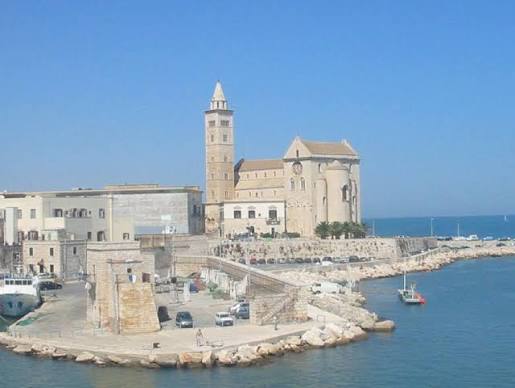
There is a moment, coming into Trani from the old town, when the cathedral simply appears — pale pink stone against deep blue sea, standing alone in its square ten meters from the water. No other cathedral in Italy sits quite like this. It is the reason to come to Trani, and it is only the beginning.
Trani is called the Pearl of the Adriatic, and for once the nickname undersells it. This is not a pretty beach town with a nice church. It is a medieval port that once wrote the law of the sea for the whole Latin West, a city where a Greek pilgrim became a saint, where Frederick II built a fortress, and where one of Europe’s oldest synagogues is a functioning house of worship again. And it sits just 45 minutes up the coast from Bari — the easiest, most rewarding day trip in northern Puglia.
A Short history of Trani
Trani’s story starts with a name on an old map. The city appears as Turenum — also spelled Tirenum — in the Tabula Peutingeriana, a Roman road itinerary, and myth credits its foundation to Tirreno, son of the Homeric hero Diomedes. The first certain news of a settlement dates to the 9th century, after Lombard and Byzantine rule.
The 11th century was Trani’s golden age. The city became an episcopal see, replacing Canosa after the Saracens destroyed it, and its port — perfectly placed for the Crusades — grew into the most important on the Adriatic. In 1063, Trani issued the Ordinamenta et consuetudo maris, the “Ordinances and Custom of the Sea”: the oldest surviving maritime law code of the Latin West. Drawn up by the city’s consuls of the sea — Simone De Brado, Angelo de Bramo, and Nicola de Ruggiero — it did something radical for its time: it treated the sailor as a worker with rights. Two of its three signing consuls were Jewish, a sign of how central Trani’s Jewish community already was. The code’s influence lasted so long that it was cited in a 1999 court judgement concerning the salvage of the Titanic.
That Jewish community is one of Trani’s great stories. From the 9th to the 14th centuries, the Giudecca quarter near the port flourished, and by 1159 it counted some 200 families. Jews served as physicians, notaries, translators, and merchants; the scholar Rabbi Isaiah ben Mali di Trani (c. 1180–c. 1250) became a major authority whose works influenced Jewish communities across Europe. In 1231, Frederick II granted Trani’s Jews a monopoly on raw silk production. The community built four synagogues within the medieval walls.
Trani’s zenith came under Frederick II himself. The emperor built the massive Castello Svevo between 1233 and 1249 to guard the harbor, and under his rule, in the early 13th century, the city reached its highest point of wealth and prosperity. Great families from Amalfi, Pisa, Genoa, Ragusa, and Venice settled here; Trani kept a consul in Venice from the 12th century, and consulates across northern Europe, even in England and the Netherlands, testified to its trading importance.
After Frederick’s death in 1250 came the long contest of Angevins, Aragonese, and Venetians — Venice held Trani from 1496 to 1509 — and for the Jewish community, persecution. In 1380, under Charles III of Durazzo, Trani’s Jews were forcibly converted and all four synagogues were turned into churches. The final expulsion came in 1510. The city was sacked again in 1799 by French Revolutionary forces. By 1881, Trani had reinvented itself as a trading point for wines, fruits, and grain — and today it is a Cittaslow town and one of the capitals of the province of Barletta-Andria-Trani, its medieval core beautifully intact.
Trani Cathedral
Trani’s Cathedral of San Nicola Pellegrino is, quite simply, the most beautiful of Puglia’s Romanesque cathedrals — and it sits like nowhere else in Italy, standing alone in its square just ten metres from the sea. Begun in 1099 on the site of a 4th-century church and completed in the 13th century, it is built from “Trani stone,” a limestone of almost unreal pinkish white that changes colour through the day, golden in the morning and pink at sunset. The 59-meter bell tower rests on a pointed arch through which the street passes, a rare feat in Romanesque architecture, and the bronze doors by Barisano da Trani (1180) are among the finest in the region. Inside, a rose window, sections of mosaic floor from the earlier church of Santa Maria della Scala, and three crypts descending one above another to the 4th-century remains reward a slow look — and the whole building is dedicated to the young Greek pilgrim who came to Trani and died here in 1094, whose relics rest in the crypt and who became the town’s saint.
10 Best things to do in Trani
1. Stand before the Cathedral of San Nicola Pellegrino
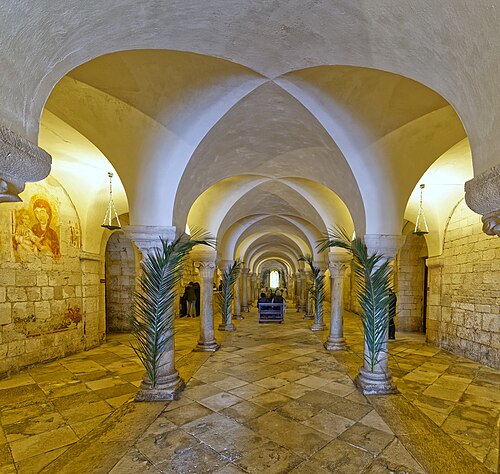
Trani’s cathedral is, quite simply, the most beautiful of Puglia’s Romanesque cathedrals. Begun in 1099 on the site of a 4th-century church and completed in the 13th century, it is built from “Trani stone,” a limestone of almost unreal pinkish white that changes colour through the day — golden in the morning, pink at sunset. The 59-metre bell tower rests on a pointed arch through which the street passes, a rare feat in Romanesque architecture. Inside, don’t miss the bronze doors by Barisano da Trani (1180), the rose window, sections of mosaic floor from the earlier church of Santa Maria della Scala, and the three crypts descending one above another to the 4th-century remains. The cathedral is dedicated to San Nicola Pellegrino, a young Greek pilgrim who came to Trani and died here in 1094; his relics rest in the crypt, and he became the town’s saint. Groups of more than seven need a timed-entry reservation — worth knowing before you go.
2. Tour the Castello Svevo
Two hundred metres from the cathedral, Frederick II’s fortress completes Trani’s medieval trilogy. Built between 1233 and 1249, it is a square plan with four corner towers, moats on three sides, and the fourth side opening directly onto the sea. Later expanded by the Aragonese, it served as military stronghold, noble residence, and even prison. Restored, it now houses a museum and temporary exhibitions — and its terrace offers the best view in town, taking in the cathedral and the harbour together. Entry is around €5; note it is closed on Monday mornings.
3. Walk the harbour at aperitivo hour
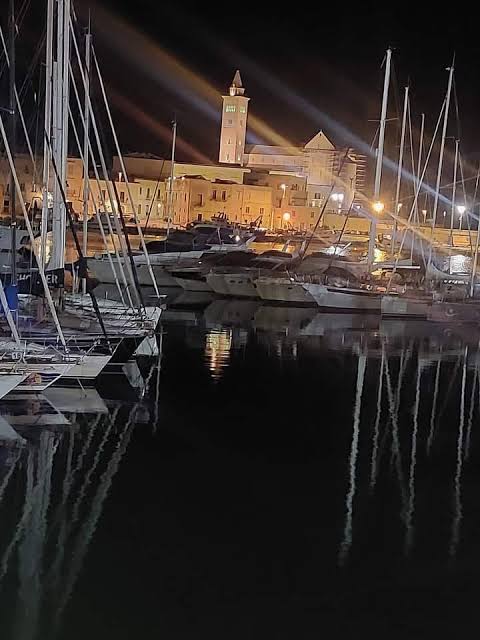
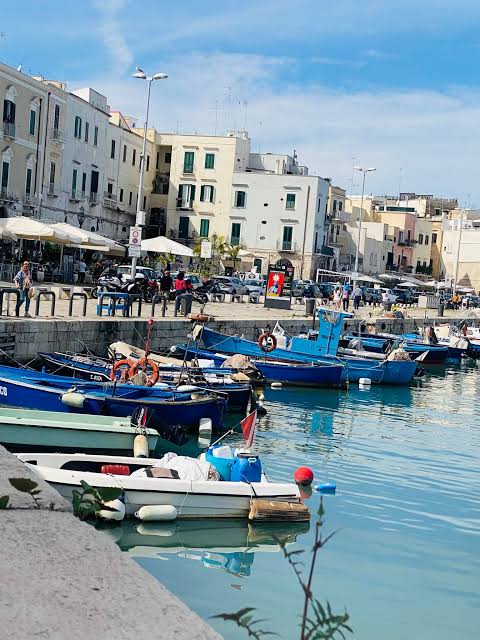
Trani’s semicircular harbour is one of the most photographed in Puglia: blue and white fishing boats lined up, ochre facades, the pinkish-white cathedral reflecting in the water. The evening passeggiata starts around 7pm on Via Statuti Marittimi, and everyone ends their round in front of the illuminated cathedral. Several wine bars on the quay serve an Aperol at sunset — this is Trani at its most itself.
4. Wander the Giudecca, the old Jewish quarter
Trani’s medieval Jewish quarter is one of the best preserved in Italy, its lanes and archways still following the medieval street plan near the port. Follow the street names themselves — Via La Giudea, Via Scolanova, Via Sinagoga, Via della Giudecca — and informational panels guide you through the quarter’s history. It is a walk through a city that was, for centuries, a genuine crossroads of cultures.
5. Step inside the Scolanova Synagogue
On Via Scolanova 23 stands one of Europe’s oldest functioning synagogues. Built in the 13th century, confiscated and converted into the church of Santa Maria in Scolanova around 1380, abandoned by the mid-20th century, it was de-consecrated and returned to the Jewish community in 2006 — a symbolic act of historical restitution, spearheaded by Professor Francesco Lotoro and his wife, descendants of forcibly converted Jews. Inside is a Byzantine painting of the Madonna dei Martiri. Remember it is a working house of worship: visit respectfully and check opening arrangements.
6. Visit Sant’Anna, the Scola Grande museum
The second surviving synagogue, completed in 1247 according to the plaque still visible on its wall, is now a museum documenting Trani’s Jewish past, with its architectural features preserved. Together, Scolanova and Sant’Anna testify to the size and cultural ambition of a community that once numbered among the most learned in the Kingdom of Sicily.
7. Find the Templars’ church of Ognissanti
A short walk from the harbour, the 12th-century church of Ognissanti — called the “church of the Templars” — is a small Romanesque building with a nave, two aisles, and three apses, its portico echoing the cathedral’s design. The Templars built it to bless crusaders before they embarked for the Holy Land from Trani’s harbour. Austere, quiet, and off the main tourist circuit, it is open on request through the parish.
8. Walk out to the Monastery of Santa Maria di Colonna
Outside the city, on a small peninsula, stands the old Benedictine abbey of Santa Maria di Colonna, with its mineral spring, the “acqua di Cristo.” The walk out to the cape is one of Trani’s pleasures — sea on both sides, and the town’s white stone behind you.
9. Stroll the Villa Comunale and the noble streets
Trani’s seaside park, the Villa Comunale, offers shaded paths and views along the water — the place locals go to breathe. Then wander Via Beltrani, lined with 17th-century noble palaces, and find the Palazzo Caccetta, a 15th-century residence built by a wealthy merchant. Piazza della Repubblica, the lively main square of shops and cafés, is where daily Trani happens.
10. Pair Trani with Castel del Monte
If you have a car, the perfect second half of a Trani day is Frederick II’s other great building: Castel del Monte, the octagonal castle and UNESCO World Heritage site roughly 40 minutes inland. The two together — the emperor’s fortress on the sea and his geometric mystery on the hill — tell the Frederick story better than either alone.
Where to Eat in Trani
Trani’s cooking is the Adriatic on a plate: the day’s catch, simply prepared, with a glass of Moscato di Trani DOC, the local sweet white wine. These are the tables to plan around, all verified for late 2026.
Pescandalo Piazza Plebiscito 6, near the Villa Comunale. An open-kitchen fish restaurant with carpacci, fresh-pasta first courses, and spoon desserts, plus Italian and international wines. . The special-occasion pick.
Locanda Trani Via Zanardelli 10. A family-run table since 1999, weaving traditional flavors of the territory with products from every region: scallops, roast octopus, scampi, lobster.
La Kambusa di Paninart — Via Statuti Marittimi 78, right at the port. Awarded as Puglia’s best fast-food restaurant, with crudo, fresh fried fish, fish tartare, and creative friselle. Try the Arrstout sandwich — roast octopus, friarelli, fig must, citrus ricotta, and pepper — praised by Gambero Rosso.
Pelledoca — Via Statuti Marittimi 30, on the harbour curve. Traditional cooking with an eye for innovation, and a wine list of more than 180 labels. Rated 4.1 from 486 reviews — the largest review base of any harbour table.
– La Nicchia — Corso Matteo Renato Imbriani 22. A seafood and Mediterranean restaurant serving fresh fish every day.
GianRi — Supportico della Conca 8. A family promise of quality: each day the kitchen chooses the best the sea has to offer, simply prepared — crudo, tartare, carpaccio, octopus, mussels.
FAQ’s on Trani
Is Trani worth visiting as a day trip from Bari?
Yes — it is the classic Bari day trip. Trani sits about 45 minutes up the coast by car or train, and its historic centre is compact and walkable. Half a day covers the cathedral, castle, harbour, and Jewish quarter; a full day adds Santa Maria di Colonna, a long harbour lunch, and Castel del Monte inland.
How long should you spend in Trani?
Half a day is enough for the headline sights at a comfortable pace. Stay for the evening if you can: the passeggiata starts around 7pm on Via Statuti Marittimi, and the illuminated cathedral is the town’s signature hour. With a car, pair Trani with Castel del Monte for a full Frederick II day.
Can you visit the Scolanova Synagogue?
Yes. Scolanova, on Via Scolanova 23, is one of Europe’s oldest functioning synagogues, reconsecrated in 2006 after centuries as a church. It is a working house of worship, so visit respectfully and check opening arrangements before you go. The nearby Sant’Anna (Scola Grande) is now a museum of Trani’s Jewish past.
Is the Castello Svevo worth visiting?
Yes, for the terrace alone: it offers the best view in town, taking in the cathedral and the harbour together. Inside are a museum and temporary exhibitions. Entry is around €5, and the castle is closed on Monday mornings — check current hours before visiting.
What is Moscato di Trani?
Moscato di Trani is the local DOC sweet white wine, and the natural partner for Trani’s seafood. Taste it at the wine bars along the harbour quay, ideally at aperitivo hour when the passeggiata fills Via Statuti Marittimi.
How do you get to Trani from Bari?
By train or car, about 45 minutes. The historic centre is compact and walkable, so you need no car once you arrive. Trani also works as a stop on a northern Puglia itinerary between Bari and the Gargano.
Practical Notes
Getting there: Trani is about 45 minutes from Bari by car or train — the classic Bari day trip, and an easy stop on any northern Puglia itinerary. The historic centre is compact and walkable; you need no car once you arrive.
How long: half a day covers the cathedral, castle, harbour, and Giudecca at a comfortable pace. A full day lets you add Santa Maria di Colonna, a long harbour lunch, and Castel del Monte.
When to go: Trani works year-round, and the harbour at aperitivo hour is good in every season. Come for the evening if you can — the passeggiata and the illuminated cathedral are the town’s signature hour.
Trani is Puglia’s elegance without the crowds: a cathedral on the sea, a castle built by an emperor, the oldest sea-law in the Latin West, and a Jewish quarter that has come back to life. Bari gives you the region’s energy; Trani gives you its grace. Do not skip it.