The story of the Olive Trees of Salento
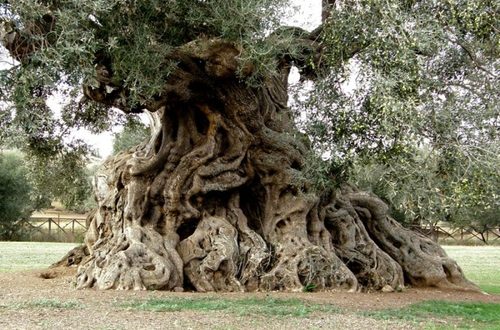
Drive through Salento and the olive trees are the first thing you notice — not tidy orchard rows, but gnarled, sculptural giants with trunks twisted like rope, some of them hollowed wide enough to step inside. They have been here for thousands of years. They were already old when Rome was young. And they are still producing the oil that made this corner of Italy famous around the world.
This is the story of Salento’s olives: the ancient trees, the centuries when their oil lit the lamps of Europe, the blight that nearly ended it all — and the rebirth now underway.
The Olive Branch as a symbol of Peace and Reconciliation
 The olive branch is one of the oldest symbols we have, and it comes from two places at once.
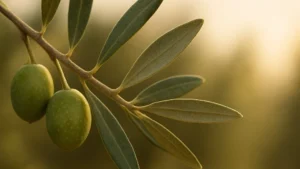
In ancient Greece, the olive tree was sacred to Athena — it was her gift to the city of Athens in her contest with Poseidon, which is why she became the city’s patron. Olive branches meant peace and victory: winners at the Olympic Games were crowned with wild-olive wreaths, and suppliants carried branches as a sign they came in peace.
In the Bible, it is the dove: after the flood, Noah’s dove returns with an olive leaf in its beak (Genesis 8:11) — proof that the waters had receded and God’s anger had passed. That image stuck and became Christianity’s shorthand for peace and reconciliation.
The Romans fused the two traditions — Virgil has Aeneas hold out an olive branch when approaching strangers as a peace gesture — and it has been the emblem of peace ever since: the UN flag has olive branches wrapped around the world, and the American eagle clutches one in its talon.
The ancient trees of Salento are the literal roots of the peace symbol.
The Ancient Trees
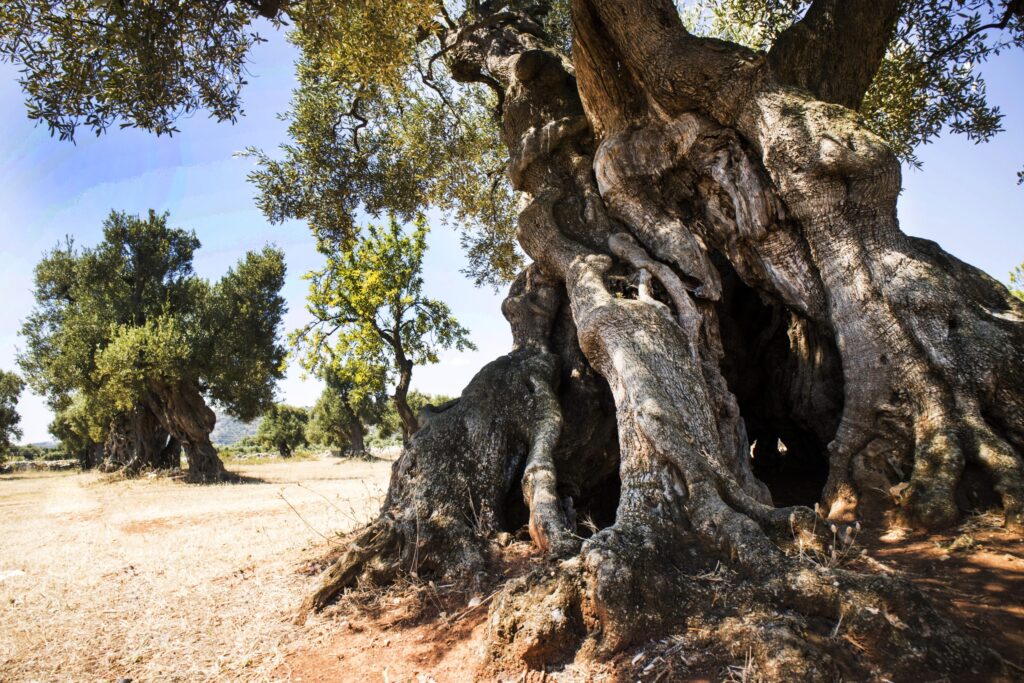
In the Salento countryside, and across the Valle d’Itria, you will find clusters of olive trees so old that Italians call them olivastri millenari — the thousand-year-old olives. Some researchers date the oldest specimens at 3,000 years or more, making them among the oldest living organisms in Europe. Their trunks can reach ten meters or more in circumference.
These trees stood in Puglia when the Greeks colonized the coast around 1,000 BC — and the olive trees likely arrived with them. They stood through the Roman roads, the Norman conquests, the Black Death, and the wars of the twentieth century. And still they grow, still they fruit.
A few you can actually visit: “La Regina” (The Queen) in Vernole, Salento — over 1,400 years old, an Ogliarola Leccese with a 14-meter trunk base, officially dedicated to Michelle Obama in 2012 during the first Mediterranean Diet Festival. At Masseria Brancati near Ostuni, monumental trees carbon-dated at more than 3,000 years old still produce fruit.
The Piana degli Ulivi Secolari, the Plain of the Millennial Olives, is seeking UNESCO World Heritage status for its concentration of ancient trees.
From Lamp Oil to Table Oil
For most of their history, Salento’s olives were not grown for the dinner table. They were grown for light.
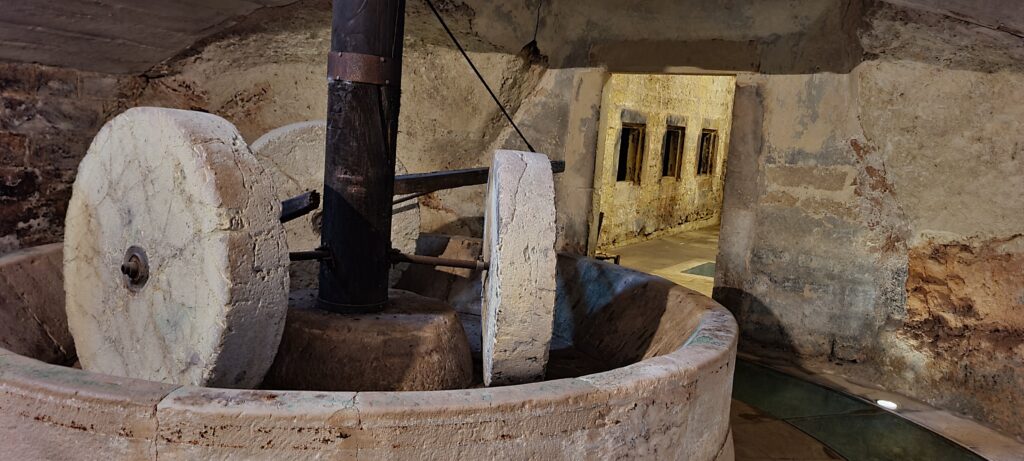
Gallipoli — yes, the seaside town — was once the worldwide capital of lampante olive oil. In the land registry of 1809–1857, the town counted 35 underground oil mills, all dug by hand into the rock beneath the old city. The oil pressed there traveled by sea to every major port in Europe, where it was burned in lamps, boiled into soap, and used in woolen mills. The great merchants of Italy and northern Europe came to Gallipoli to trade linen, spices, sugar, timber, and iron for Salento’s “Apulian gold.”
You can still go underground in Gallipoli today: the Frantoio Granafei, accessed from Via Antonietta De Pace in the old town, is a vaulted hypogeum mill carved from tuff, with its original grinding tanks, stables, and oil collection wells. Standing in it, you understand the scale of the industry — this was not a farmhouse press, it was an energy economy.
The shift from lamp oil to food oil came with electrification. When the lamps went dark, the mills had to reinvent themselves — and the same groves that had fueled Europe’s lighting began producing some of the finest extra virgin olive oil in the world.
The Volume and the Quantity
The numbers are staggering. Puglia produces around 40% of Italy’s olive oil — roughly 12% of the entire world’s production — from some 60 million olive trees spread across nearly 400,000 hectares. More than 240,000 farms press oil here. In a good year, the region produces over 100 million liters.
But Puglia’s reputation was never built on volume alone. The flagship variety, Coratina, produces one of the most intensely flavored, polyphenol-rich extra virgin olive oils on the planet — peppery, bitter, almost spicy, the kind of oil that catches in your throat (which, counterintuitively, is the sign of quality).
Salento’s native varieties — Ogliarola Salentina, Cellina di Nardò, and Leccino — give softer, fruitier oils, often bottled under the Terra d’Otranto DOP, one of several protected designations in the region alongside Terra di Bari and Collina di Brindisi.
Why is it valued above oils from elsewhere? Three reasons. The climate: hot, dry summers and constant Adriatic wind stress the trees into producing smaller, more concentrated fruit loaded with polyphenols.
The heritage: 2,500 years of selection have produced varieties tuned to this exact soil. And the market agrees — Italian extra virgin consistently commands higher prices than Spanish, Greek, or Tunisian oil, and Puglian oil sits at the top of that ladder.
The Blight and the Rebirth
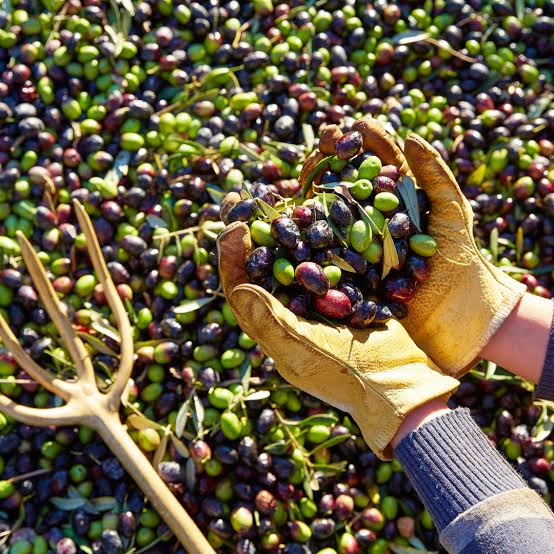
In 2013, a bacterium called Xylella fastidiosa was detected in Salento’s olive groves. Spread by sap-feeding insects, it chokes the tree’s water vessels. There is no cure. What followed was one of the worst plant epidemics in European history: more than 21 million olive trees dead, including thousands of monumental specimens. The landscape that had defined Salento for millennia turned silver-grey with dead wood. The varieties hit hardest were Salento’s own — Ogliarola Salentina and Cellina di Nardò.
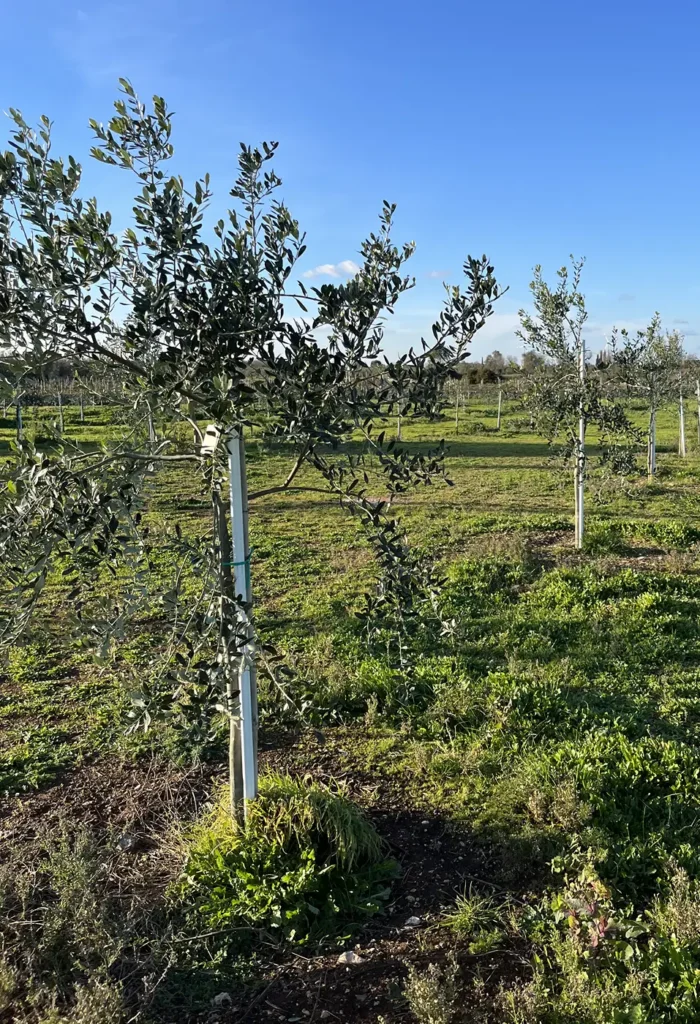
But this is not a story that ends in ashes. Researchers identified resistant varieties — Leccino and FS-17 Favolosa chief among them — that carry the bacterium with mild or no symptoms. Across Salento, farmers have been clearing dead groves and replanting with resistant cultivars, sometimes grafting them onto the ancient rootstocks of the old trees.
It is working: the farm union Coldiretti expects the Lecce province harvest to rise by roughly 60% in the 2026/27 season as the replanted groves come into full production.
Drive through the Salento countryside today and you will see both chapters at once — the skeletal remains of the old groves, and beside them, neat rows of young resistant trees already heavy with fruit. The rebirth is visible from the road.
Puglian Olive Oils vs. Tuscan Olive Oils
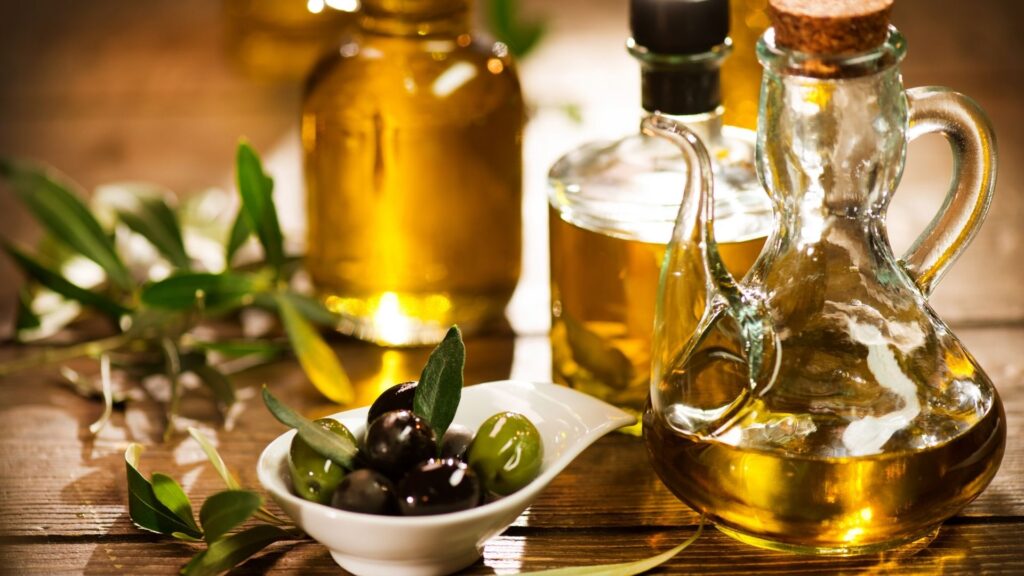
Puglian and Tuscan olive oils are genuinely different animals, and “better” depends on what you want from the bottle. Puglia’s oils — led by the Coratina olive — are bold, peppery, and bitter, with some of the highest polyphenol levels in the world; they’re intense finishing oils that stand up to grilled meats, bitter greens, and hearty Salento cooking, and they deliver remarkable quality for the price. Tuscan oils, built on Frantoio, Moraiolo, and Leccino olives grown on cooler hillsides, tend to be more elegant — grassy, with artichoke notes and a refined peppery finish — but they come in smaller quantities and command higher prices, partly on prestige. The honest verdict: Puglia wins on intensity, health compounds, and value; Tuscany wins on refinement and name recognition. A serious cook keeps both in the kitchen.
Where to GO: The Best Olive Oil Experiences
– Masseria Il Frantoio (near Ostuni, ~1 hour from central Salento): the famous one, and worth the drive. Seventy-two hectares of ancient organic groves, a 16th-century underground mill, and a sommelier-led tasting of four organic oils. Note: their ancient underground mill was damaged by flooding in September 2026 and is being restored — confirm the underground portion of the tour is running before you book. masseriailfrantoio.it
Schirinzi Olive Oil (Carmiano, ~15 minutes from Lecce): a family-run Salento mill where the welcome is as warm as the oil is fresh. Visitors taste at the source — the Boschino, all fruity intensity for drizzling over bread and salads, and the Santa Lucia, a smoother, more versatile everyday oil — plus their flavored oils, with expert advice from the owner himself. Reviewers rave about the freshness and the personal touch, and the practical Bag in Box format keeps the oil fresher longer at home. The closest authentic mill visit to Lecce, and an easy stop on any Salento itinerary.
– Masseria Cantasole (Brindisi area, ~35 minutes): a working 13th-century masseria where a certified EVOO sommelier walks you through three award-winning oils, followed by a Salento-style aperitivo and local wine in the courtyard. cantasole.com/pages/visit-us
– Frantoio Granafei (Gallipoli old town): the underground mill described above — the most atmospheric single stop for understanding the lamp-oil era. Combine it with a walk around the island old town.
– Underground mill tour near Otranto: a bookable guided visit to a 16th-century hypogeum mill carved into a natural cave, ending with a tasting of organic oils on rustic bread (bookable on GetYourGuide).
– The millenari themselves: walk the Piana degli Ulivi Secolari, or visit “La Regina” in Vernole, to stand beside trees older than most nations.
October is the ideal month: it is harvest season, the mills are pressing, and the new oil — green, peppery, alive — is flowing
.
Olive Festivals
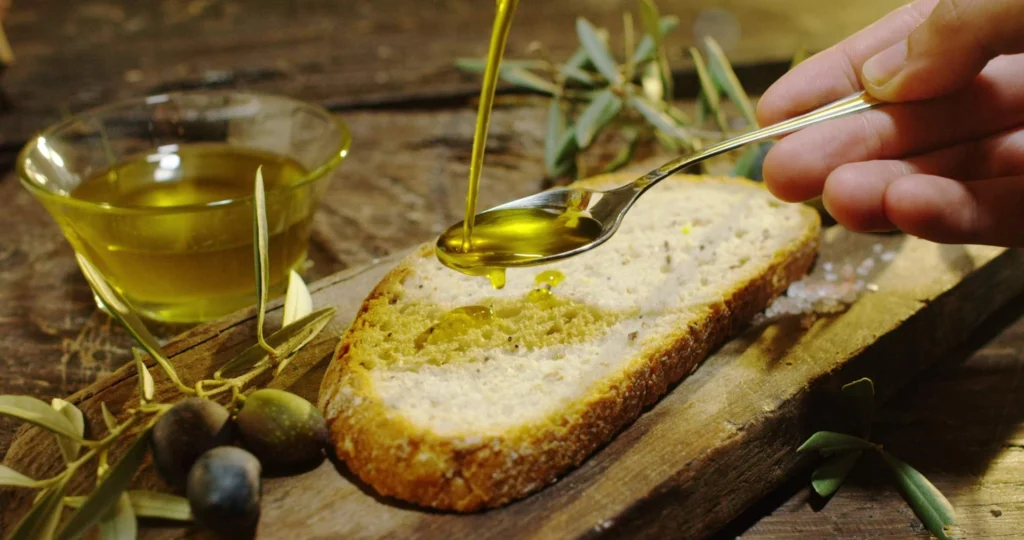
Salento’s great olive celebration is the Sagra de la Volia Cazzata in Martano (Grecia Salentina), held mid-October — in 2026, October 15–18. It honors the volia cazzata, the crushed table olive: green olives smashed with wooden mallets, cured in brine with oil, garlic, chili, and salt. Free tastings, Salentine food stands, pizzica music, and a Sunday tasting lunch. It is the festive face of the harvest. voliacazzata.it
Other Fun Festivals in Puglia
Salento Olives FAQs
What is the best month to visit Puglia for the olive harvest?
The harvest usually runs from October into November, and October is the sweet spot. The mills are pressing, the countryside smells of fresh oil, and you can taste olio nuovo — the just-pressed new oil, green and peppery — at its peak. Book tastings ahead if you are coming in late October, as harvest-week slots at the best masserie fill fast.
How can I tell real extra virgin olive oil from a fake or low-grade bottle?
Check the label for three things: “extra virgin” (not just “pure” or “light”), a harvest or best-before date within the last 18 months, and an acidity level of 0.8% or below — genuine extra virgin must meet that by law. A single named estate or DOP on the label is a far better sign than a vague “packed in Italy” blend. And trust your throat: real extra virgin often leaves a peppery tickle.
How long does extra virgin olive oil keep, and how should I store it?
An unopened bottle is best within about 18–24 months of harvest; once opened, aim to use it within two to three months for full flavor. Keep it in a cool, dark cupboard — never on the stove or a sunny windowsill, and never in the fridge, which causes condensation. Dark glass or tin is better than clear bottles for the same reason: light is oil’s enemy.
What does “cold pressed” actually mean on an olive oil label?
It means the oil was extracted mechanically — crushed and centrifuged — without heat or chemicals, at temperatures kept below about 27°C (80°F). Heat speeds up extraction but destroys the delicate aromas and healthful polyphenols that make good extra virgin special. You will also see “cold extracted” for modern centrifuge mills; for top-quality oil, the two terms mean the same thing.
Can I bring Puglian olive oil home with me on the plane?
Yes — in your checked luggage, packed well. US travelers may bring olive oil for personal use without duty on reasonable quantities; EU travelers face no restrictions within the union. Buy from the mill or a frantoio directly and ask them to seal and wrap the bottles, or ship a case home — many estates ship internationally, which saves your luggage weight and your nerves.
Is there a right way to taste olive oil?
Pour a small amount into the little tasting cup, warm it in your palm for a few seconds, then sip and slurp loudly — the slurping aerates the oil across your palate so you catch the bitterness, fruitiness, and pepper. Professional tasters do this with bread or plain grissini between oils to reset. Do not feel silly making noise; in a Puglian frantoio…
the loudest slurper is the most serious taster. 
What is the difference between DOP and IGP on an Italian olive oil label?
DOP (Denominazione di Origine Protetta) means every step — growing, pressing, bottling — happened in one defined area, like Terra d’Otranto in Salento. IGP (Indicazione Geografica Protetta) is looser: at least one stage took place in the named region, but the olives may come from elsewhere. When you want the truest taste of a place, reach for the DOP.
Can I get an olive-oil massage or wellness treatment in Puglia?
You can — several masserie and agriturismi with spas in Salento and the Valle d’Itria offer treatments built around local olive oil, from massages to skin rituals. Olive oil has been used on skin in the Mediterranean since antiquity, and the warm, simple versions here beat a fancy spa menu anywhere. Ask when you book your stay, as the spa treatments are usually reserved for guests.